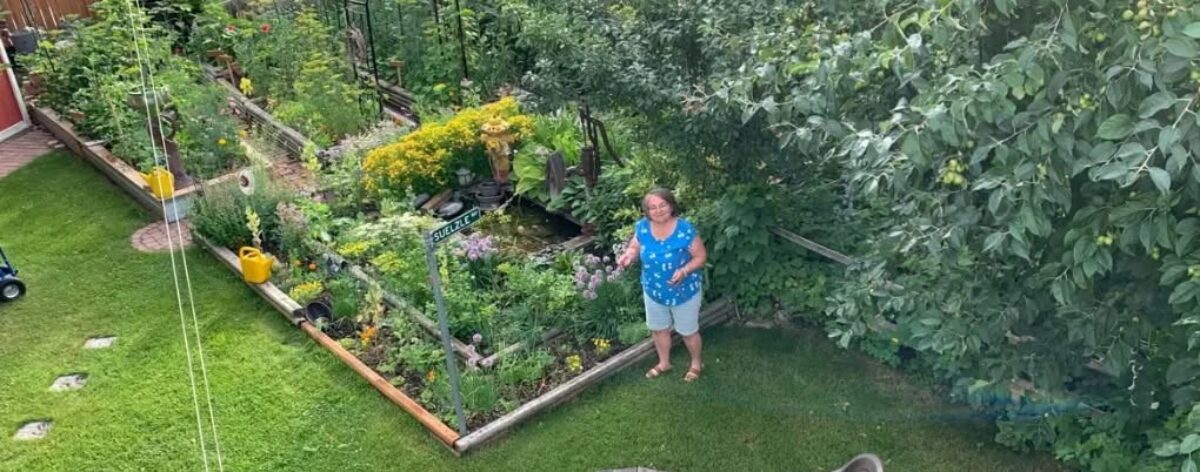
at the time of writing this, I am in the middle of RHUBARB Season – first part of July
Rhubarb is my best friend in the early part of the season. And stays my long suffering, generous, faithful friend right through till the cold puts it to bed at the end of the season. I try not to pick too much at the beginning of May when its first coming on, or in September when it’s getting tired, but other than that, the bounty is profuse!
Jam is one of rhubarb’s strengths. It can stand on its own – plain rhubarb jam – and be wonderful. Or when you pair it with strawberries, raspberries, honey berries, saskatoons or plums (or other summer fruits), something magic happens. Rhubarb, that ever generous friend – moves into the background and acts as a flavour ‘enhancer’. The taste of strawberries will prevail. Or raspberries. Or whatever. So why bother using rhubarb, if you can only identify the taste of raspberries?

I hardly ever make pure raspberry jam unless I have such a bumper crop that I don’t know what else to do with them. We use them ‘fresh’ every single day. Out of hand of course, on cereal in the morning, on salads, in desserts, in smoothies, . . . . I love to make a couple beautiful raspberry pies in the summer. I fill my freezer with raspberries to use all winter long. We wait a whole year for raspberries to come on, and there’s nothing quite as wonderful as ‘garden fresh’ raspberries, but their season is only a few weeks long and then they’re done. I am highly motivated to not miss them. Rhubarb on the other hand, just keeps on giving and giving. Rhubarb extends the raspberries. It’s like that. The quiet, subtle friend who stands in the background, making you look good and getting all it’s satisfaction from doing so. How can you not love rhubarb?
The other thing I love about rhubarb jam is that it doesn’t need a lot of sugar, and though it doesn’t have natural pectin, it sets up beautifully, in the consistency you’d want to spread on your morning toast. If you’ve made the typical pectin recipe for any kind of jam, you know there’s more sugar than fruit in it; sometimes double the amount. yikes! That kept me from loving jam, and certainly from making a lot of jam most of my adult life. In fact, the current pectin recipe for rhubarb jam calls for 3 cups chopped rhubarb with 5 cups sugar, a pouch of pectin and even a few drops of red food colouring. yikes again! That’s a LOTTA sugar! And I hate using food colouring. That’s another reason I often pair rhubarb with other fruit for jam. Rhubarb isn’t all red, and when you cook the jam, it can sometimes be a little ‘brownish’ (hence the food colouring in some recipes). Adding other fruits half way through the process adds COLOUR!
Compare the typical ‘certo pectin’ ratio above (3:5 / 3 parts rhubarb to 5 parts sugar) to the amount of sugar used in my recipe below (3:1 / 3 parts rhubarb to 1 part sugar).
🌸 Truth is, as sour as rhubarb is, it doesn’t need nearly as much sugar as we usually add.
I know—that sounds completely counterintuitive. But stay with me… and be open to trying something that might not make sense at first.
Trust the process. Give it a taste before you reach for more sugar. You might be surprised.
And if you still feel it needs more sweetness? No problem—you can always add another cup later.
Here is my basic rhubarb jam ‘recipe’. Keep in mind that when preparing it, these amounts are my ‘suggestions’. I am not precise in my measurements, I use them as guidelines. I taste along the way to reach the level of sweetness I desire.

🍓 Rhubarb Raspberry Jam
This recipe yields about 5 pints.
I typically can 4 pints for the pantry and keep the remaining jar in the fridge to enjoy right away—or to share with a friend.
12 cups chopped rhubarb
2 cups sugar TO USE TO MACERATE YOUR RHUBARB
2-4 cups raspberries
1-2 more cups sugar (as you decide– taste test it)
* 1/2 lemon pureed in blender to use as natural pectin
- Put a small lunch plate in the freezer. You’ll need it at the end.
- How finely you chop is gonna influence how much rhubarb fits into a cup right? So shoot for about half an inch size pieces. Don’t use a one cup measuring cup. Use a bigger bowl. Pictured above is an 8 cup measuring bowl. Heaping is about 12 cups.
- 🍃 To macerate your rhubarb
Measure your rhubarb and place it into a large Dutch oven or bowl. Sprinkle 2 cups of sugar over the top, then gently toss to distribute it evenly.
Let it sit for at least one hour to macerate (see note 1 below). I often leave mine much longer—sometimes I chop the rhubarb in the evening and let it sit overnight. Not because it’s necessary, but simply for convenience. When you’re juggling a few things, it helps to work in stages.
By morning, the sugar will have softened the rhubarb and drawn out a surprising amount of liquid. Strain off this liquid before cooking—it makes the process much easier, with less moisture to cook down.
Don’t discard that liquid—it’s amazing!
Pour it into a jar and refrigerate it for later use. - In a large pot, put the rhubarb on medium high heat and bring it to an easy rolling boil, stirring every few minutes to prevent scorching. You don’t have to stir constantly, but don’t go leaving the room and forgetting about it on the heat. Just try to stay close at hand so you can give it good attention, stirring frequently. I generally use this time to wash the jars, get the hot water bath boiling in another pot on the stove, and other general kitchen clean up. You can expect the process to take up to an hour.
🍋 This is where the lemon comes in. - Citrus fruits are naturally high in pectin—lemons especially so—and most of that pectin is found just under the peel. Adding lemon does more than bring that bright, fresh “zing.” It also helps your jam set beautifully and keeps the colour looking vibrant and appealing.
Plums can also contribute pectin (depending on the variety), but lemon is the real star here.
Pour the puréed lemon into the jam and stir well to distribute it evenly throughout. - Continue cooking, adjusting heat as necessary. You’re looking for a good steady boil. You’ll see it begin to thicken after the first 15 minutes, continue stirring. As it thickens, the boiling will cause it to spit at you. Nothing you can do about that other than to wear an apron and be prepared to wipe up as necessary. Lowering the heat might help a little, but it will add a few minutes to your time. It’s just gonna ‘spit’. About half an hour in, add the raspberries. Stir well, taste and add another cup of sugar to sweeten. Stir while continuing to boil, and taste again, adding another 1/2 cup sugar at a time (as you decide) till you like the sweetness.
You may find during the cooking process that a foam begins to form on top of the jam. With some jams or jellies it can be quite substantial. It shouldn’t be that much with this jam, so I just stir it in. But if you don’t like it, skim it off. - In approximately an hour, perhaps a little less, you may decide it is thickening enough. Test the consistency by turning your spoon and dropping jam back into the pot; you’ll know when you like what you see (not too liquidy). Remember, it will set up a bit more as it cools. Take your small plate from the freezer, and drop about half a teaspoon of hot jam onto the plate. Don’t worry, that amount isn’t gonna break the plate. You’re trying to cool the jam quickly with this process. When the jam has cooled, draw your finger through it. If the two sides of jam stay separated, your jam is a good consistency. Turn the heat off.
- Your jam is done.

If you plan to seal it for long term storage, ladle it into clean* (2,3 see below) jars using a canning funnel. Allow plenty of head space in jar.*(4 see below) Wipe with warm cloth to ensure the ridge is perfectly clean. Put a clean lid on, fasten it finger tight with the ring, and lower it on a slant into your boiling hot water bath.*(5 see below) Make sure each jar is covered by at least an inch of water. You may have to add a little water. If you do, pour into the side of the pot, never directly onto the jars.
Begin timing when the water returns to a boil. 10 minutes.
When the time is up, remove from water with a jar lifter, and place on folded clean tea towel on the counter. Allow air space between your jars. Lightly cover with another clean cloth and let the jars cool. You will hear a ‘pop’ sound as the jars seal.
I made this jam three times in the last week or two. First one, I used 4 cups of sugar total. Second batch, I used 3.5 cups total. Last one, I used 3 cups. It was just enough – deliciously TART without being sour. My personal favourite.
🌿 I hope you’ll try making rhubarb jam this way . . .….
—on its own, or paired with whatever fruit you have on hand. I often reach for raspberries from the freezer—last year’s bounty—and they work beautifully.
When it comes to sugar, you’re the boss.
Be brave. Dare to use less.
Taste as you go and adjust along the way—that’s the best way to avoid surprises and end up with something you truly love.
Let me know how you love it.
Warmly,
Cindy Suelzle
footnotes:
- Macerate means to soften – in this case, with sugar and time
- I recommend using pint sized jars (2 cups), or half pint jars (1 cup)
- 🫙 A note on jars and sterilizing
I don’t pre-sterilize my jars. I wash them thoroughly in hot, soapy water, rinse well, and let them air dry.
When I’m ready, I ladle the hot jam into room-temperature jars, then place them into boiling water for processing.
Hot jam → hot water.
Jars do not need to be sterilized ahead of time if they will be filled and processed in a boiling water bath for at least 10 minutes, or if they’re going into a pressure canner.
If your processing time is less than 10 minutes, then sterilizing the jars beforehand is recommended. (Though honestly… what are you canning for less than 10 minutes?) - Headspace is the space between the contents and the top of the jar. You want to leave enough headspace so that the food can swell and move about as it’s heated without boiling up and out of the jar, but not so much that there is an unnecessarily large quantity of air which may interfere with vacuum sealing it. If jam overflows, it will affect the integrity of the seal of the jar. Fill only to the bottom of the jar neck to allow for a vacuum to be created sealing the jar.
- If you are using a large pot as a makeshift canner, make sure you have a rack or a folded tea towel on the bottom to keep your jars off the bottom of the pot. Failing to do this may result in jars breaking.
🌿


