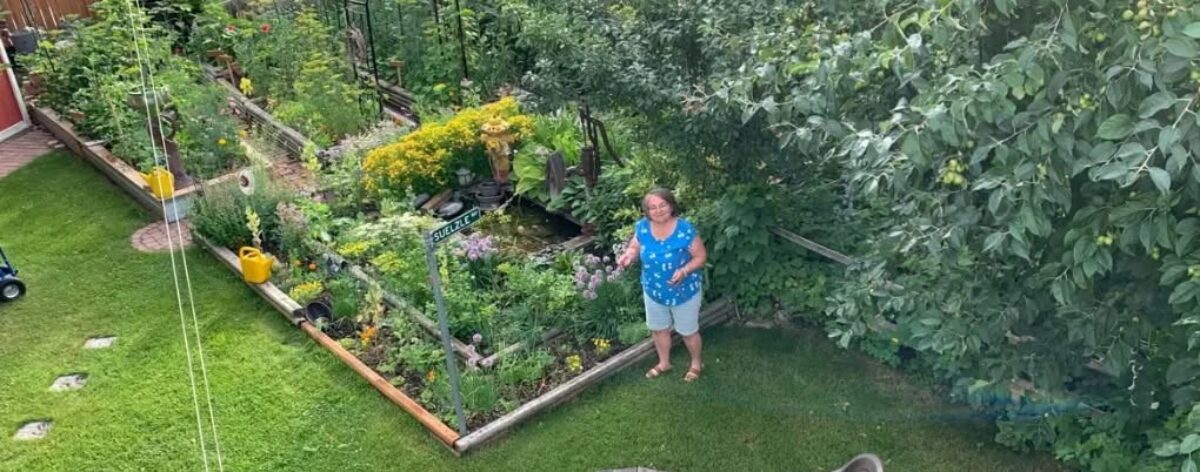
I had just laid my head down after spending another few hours in the garden that spring evening ….. finally got most of my herb plants and a few more flowers IN . . . when I heard it.
ARGHHHHH HAIL!
Hail. I hate hail. That great equalizer. Natures way of reminding us who is in charge, and that we are always dependent on Him. Big mistake to rely solely on “the arm of flesh”.
I timed it.
From beginning to end less than six minutes. But I knew it wouldn’t take more than that. It never does. It doesn’t have to. I mentally went through my garden beds and realized there was no one or two places that I could reasonably even hope to cover. If I had had warning. I was completely at the mercy of hail. My thoughts turned, as they often do, to my great grandparents who repeatedly got hailed out on the prairies after putting in all their blood, sweat and tears. I thought of them standing there, at the door, watching the hail fall, weeping. Not much else to do. . . . . And as always, my heart went out to them. My people. Most of whom I’ve never even met.
early family garden in the city when the kids were little, around 1989
For me hail means frustration, disappointment and inconvenience. For them it meant everything! For them it could have cost them their entire year, and they would have wondered how they were gonna feed their family in the winter to come. I knew there was nothing I could do but hope and pray. Just as they knew there was nothing more they could do.
I went out the following morning to check my gardens. Fine. I checked each plant I put in last night. Fine. All fine. If I hadn’t heard the hail storm the night before, I likely wouldn’t even have known about it. I am relieved. And I am grateful. And again as I do so often, I wondered “why I am so favoured?”. And I love and appreciate all the more, those people who came before me, to this land. And paid such a high price, so that I could have what I have, a long time after they’re dead and gone. Thank you. Thank you to Charles and Sarah, to Alonzo and Elizabeth, to Andreas and Inger, Pearl and Leland, Heber and Capitolia, and all the others who sacrificed so that my children could be born HERE in this place, NOW in this time. The fullness of times.
And I thank my Heavenly Father again for the bounty we enjoy in this land. And I recommit myself to Him, with the reminder that I am nothing without Him. All I can do for myself can be wiped away in 6 minutes, or less. Yes, I will continue to work hard. But in Him alone will I put my trust.
In the name of family and of all that is good in this world, we have this beautiful, tender scene painted by Robert T. Barrett – of two brothers embracing. It is a scene of forgiveness, and one of a shared bond that was ultimately stronger than differences. After two decades of separation, caused by two opposing perspectives, offence given and offence taken, misunderstanding and vengeful anger, they come together on a field that could have just as likely, been a bloodbath. Every reason to hate still valid, because though a lifetime had lapsed, the facts still remained. The ball was in Esau’s court so to speak, he could have gone either way. He may have even been uncertain himself, after all he came out to meet Jacob with 400 men. But there. On that field. After long absence, and tremendous mutual familial loss, including the death of their mother in Jacob’s absence, we see one of scripture’s great lessons on forgiveness.(1) Esau let go. There was no chance of bringing back what was lost, nor of undoing what had been done, and to persist in a attitude of vengeance would only cause further hurt and further loss.
Esau and Jacob Embrace by Robert T. Barrett
At what point does one say “Enough is enough. And this truly IS enough!” ? Does it take a year? a decade? more? A veritable lifetime of separation? Does it take the death of a parent? Wherever that point was for Esau, he had reached it and crossed over. And though Rebekah did not, Isaac lived to see it. I can scarce imagine the gut wrenching sobs and father-tears of both grief and joy to hear the news and to feel with his very own hands (for his sight had long ago failed him), both of his boys at the same time. I’m sure he had all but given up hope that he ever would.
Such a reunion! And how could Rebekah not have looked on with similar emotion from her heavenly vantage point? Brothers. Sisters in law. Cousins who never knew each other. Each family had followed a different path, and their futures wouldn’t necessarily be intertwined, but old grudges were gone and peace could once again prevail, as they parted ways, this time with mutual acceptance and respect. “That’s what its all about, ” says singer songwriter Sam Payne “Having good reason to hate each other and not hating each other anyway.” (2)
Most of us can pull an Esau-Jacob story from our family files. Maybe they ended well, maybe they have not yet. For me, I have a few. Some are not quite completed. One saw resolution many years ago, and has gone on to yield life long loving familial relationships, and eternal blessings not even imagined before. My dad came from a large family of sixteen natural born children. Fourteen of those children grew to adulthood and had families of their own, and yes, you’re right – that makes for a lotta cousins for me. When I was very young, we lived many hours drive from my grandparents. We generally saw them once a year. But my Harrison cousins, many of them also lived many hours drive, and I saw them seldom. We had our very first “Harrison” family reunion when I was in elementary school. In Waterton park. I was shy around so many aunts and uncles and cousins. I had a brief but memorable exchange with one cousin from far away during that reunion. I didn’t know how we fit together, but the adults told us we were cousins, so we played. Her name was Jerilyn. We were the same age and we shared the same last name because our dads were brothers. We had been playing together for a time when her family got ready to go on a planned outing; she invited me to come with them. I’m not sure what motivated me to accept, as they were virtual strangers and I was very shy, but I did, and my mom consented. Her dad was an anomaly to me. He was soft spoken and kind. He laughed – with children! He genuinely seemed to want to be with them. He spoke to me directly. He told dad jokes and my cousins were easy and comfortable around him. My memory of that event is brief, and would have faded altogether I believe, had it not been for a converging of our two families only a few short years later.
Sometime in my childhood, whether before or after that reunion I don’t know, my father had been sent to Winnipeg on an assignment. He was in the Royal Canadian Air Force (as it was called then). While there, he was invited to dinner at his brother’s house. This same brother, who also served in the Air Force. My dad was a couple of years older, both in their mid 30’s. By all accounts, dinner went well. I’m sure it was delicious – my aunt was a good cook. I’m sure my cousins were well behaved, there were 4 of them. All girls. After dinner, my dad pulled out a cigarette as was the habit of smokers. It was no secret that he smoked. Most adults did in those days, certainly the ones in my world. Whether it was my aunt or my uncle who asked my dad not to smoke in the house, is unclear, but my dad attributed it to Aunt Jolayne. He went outside on the front porch to have his cigarette. It was winter. He might have been mildly annoyed at first, but as he stood there smoking, he became increasingly annoyed – even offended. It is so common for people to not smoke in homes nowadays that it may be difficult to imagine a time when it was not only acceptable, but very common. My dad was easily offended at the best of times, so this was the perfect opportunity to do what came naturally for him. As he blew smoke out, he became quite indignant at having to do so outside. In the winter no less. And he walked away. Building up a defensive wall with every step. He had been insulted in the house of his brother. Offended. Never would he darken his door again. My uncle’s wife had insulted my dad, and by association, so did he. They were intolerant and inhospitable, and judgmental, and rude. The extent of the perceived offence grew as the distance between them grew. I can only imagine what that may have felt like from the perspective of my aunt and uncle inside the house. Especially if they watched my father walk away. They had all been raised in southern Alberta “Mormon” towns, in Mormon families. Both families lived by the tenants of their religion and keep the word of wisdom – which included abstaining from tobacco, alcohol and tea and coffee. My dad was one of the brothers who deviated from the family religion.
Distance and time created more distance and time, and as sometimes happen, the wound festered. You could say it had even become infected. I didn’t know my aunt and uncle, and I didn’t know this story, until when I was ten years old we learned that they were moving to our base. My uncle Merlin had been transferred to the airforce base in Cold Lake, Alberta. As children, we couldn’t even imagine what having cousins live so close might be like. My parents did not seem happy about the news, so we were filled with concern, but secretly, I was just a little excited at the possibilities. The old wound however resurfaced, and if we had missed it before, we understood more fully now how significantly bad it was. I didn’t even know what my Aunt Jolayne looked like, but I knew she was a “religious fanatic“. I knew she kicked my dad out of her house for smoking. On a winter day! Smoking in my world was like breathing. Every adult did it. Her action was unimaginable and there was no question that it was unforgiveable. We prepared for the worst.
My uncle came ahead and lived temporarily in the barracks while he waited for a PMQ, and for his family to arrive. One night we invited him for dinner. My dad wasn’t home, so my mom and I went to the barracks to pick him up. We shared a meal with this stranger who we knew was our uncle, and he was . . . nice! And kind. He brought us gifts. Hot chocolate mix, something we had never seen before. All four of us got our very own, which my mom protested was too generous, but he insisted and we were very happy. He was complimentary of the meal, and spoke easily with all of us, even directly to us kids. He asked about our interests and school. We didn’t know how to take him – I had not taken note of too many times in my life that an adult other than a teacher, had spoken directly to me, let alone being interested enough to listen to my response. After dinner, he sat at the table with me as I did my homework. I was writing some kind of report about the pyramids in Egypt, using our ‘Book of Knowledge’ encyclopedia. He told me he had been to Egypt! He had seen the pyramids, the very ones in the picture we looked at. I had never met another man like him in all my long life of ten years. I went with my mother to drive him home and listened to them chat in the front seat. When he got out of the car and waved goodbye, I said to my mom “I like him.” She said “I like him too.”
Sometime after that dinner, Uncle Merlin’s family arrived. They came to visit us and we may have had supper together. We cousins became acquainted with each other. I showed my cousin Shawna my guitar, and played her a song I was learning. Having cousins live in our community was such a strange idea. They would even be coming to our school!
When they got settled in their new house, they invited us to dinner. We were all familiar with “the story” by then, and we wondered how it would play out. We were not just a little apprehensive, and I seem to recall my mom reassuring my dad that all would be well, and that he could suck it up for one evening. After all, he had sworn to never go there again. It was . . . our field. And quite literally, it was our Esau and Jacob moment. Though our two households had had touch-points, we had never as a family, been in their ‘home’. We went, my dad – less willing and still carrying his comfortable crutch – a ‘grudge’. He had after all, been offended, and that could not be forgotten, nor set aside.
When we arrived, they met us at the door and welcomed us in. My aunt Jolayne handed my dad a clear, glass ashtray, purchased for this occasion. She told him “Wes, you can smoke in my house any time you want.” To this day, I cannot think of that single gesture without weeping. I don’t recall my dad’s response, but on the drive home, he said to my mom “Well, if that doesn’t beat all. All these years, she hasn’t forgotten. It has been eating at her like it was eating at me.” He affirmed that never in this life, would he be disrespectful enough to smoke in Aunt Jolayne’s house, but that thoughtful gesture skyrocketed her in his esteem. His dislike transformed almost instantly into admiration, even respect. And over the years that we both lived in Cold Lake, it evolved into love. We spent many happy hours in the company of Uncle Merlin’s family. My dad was a better dad in his brother’s company. Without being too dramatic, it set the wheels in motion for not only life altering changes in my life, and life long friendships between our households, but eventually, the sealing of our family as an eternal unit. That is another story for another time. A story of my utter love and gratitude to Uncle Merlin’s family, and for all that came from the seemingly insignificant gift of a small glass ashtray.
Destructive conflict is “when our inability to collaboratively solve problems with others leads us to hurting others or ourselves.” so says Chad Ford, Professor in Intercultural Peacebuilding at Brigham Young University-Hawaii. “With destructive conflict comes a fear of pain both in anticipation and as a consequence of the conflict, a fear of not being loved or seen the way we want to be seen . . . .” (3) Though our dislike of someone who has offended us may devolve into hatred, hopefully it doesn’t de-escalate to the murderous level Esau’s did. He had sold his birth right to Jacob for a bowl of lentil soup (see Genesis 27: 6-29). At the time, he didn’t have proper respect for the value of his inheritance, and when the time came that he had to own his choice, and live with its consequence, he hated Jacob. So great was that hate, that he swore to kill him. Knowing the violent propensity of their elder son, both Jacob’s parents encouraged him to leave home and to travel to the distant land of his mother’s people – where he could not only find temporary refuge, but also find a wife among believers of the one true God. For two decades, Jacob lived among his mother’s people, marrying two of her brother’s daughters, and accumulating for Laban (his father in law), great wealth by his industry and the blessings of God. Laban recognized that God was with Jacob. At length, God directed Jacob that it was time for him to return to Canaan, the land of his inheritance, which in conference with his wives, he set about to do.
As they travelled and neared the place where he grew up, Jacob worried about Esau and his murderous grudge. He prayed for help. “Deliver me, I pray thee, from the hand of my brother, from the hand of Esau: for I fear him, lest he will come and smite me, and the mother with the children.“(4) He sent notice announcing that he was coming home. His servants returned, telling Jacob that they delivered the message and that Esau was in fact coming out to meet him. With four hundred men! – a veritable army. Rightly fearing his brother’s intent, Jacob separated his company into two groups, reasoning that if Esau attacked one group, the other would have time to escape. He separated generous gifts and sent them ahead with instructions to graciously deliver them to his brother, hoping to communicate his desire to reconcile before they met face to face. Unbeknown to Jacob, Esau may have already reached his peace. Whether Esau had forgiven him before that day, or whether it was a gradual transition, softened by the demonstration of good faith as he was offered generous gifts, we’ll never know – and he himself may not even have known. And it doesn’t even matter. What mattered was that he allowed the gesture to touch his heart, and he was softened to his brother. (My dad was softened toward his brother and sister in law, but it wasn’t until the gift of the ashtray, that he finally allowed the sweet spirit of charity, the gift of final forgiveness to take hold and sooth all that had passed – never to be revisited except to recount a happy outcome.)
Brother’s Road by singer songwriter Sam Payne
When they came within view of each other after so long, Jacob prostrated himself respectfully, and was no doubt surprised that “Esau RAN to meet him, and embraced him and fell on his neck and kissed him; and they wept.“(5) What a glorious scene! Can anything be more beautiful than unresentful reconciliation, powered by true and open forgiveness, a letting go of a former grudge? Who cares what past offense fueled it? In this beautiful story, we see the example of truly “letting go”, of genuine and sincere forgiveness. Of charity in its truest form – which scripture defines as the pure light of Christ. “Deciding to love those who could hurt us allows us to push past fear and become filled with charity.” says Chad Ford. “Love allows us to see our brothers and sisters we are in conflict with, so clearly that THEIR needs and desires matter as much to us as our own . . . . We’ll do whatever it takes to find solutions that meet their needs as well as our own.” (6)
“It took courage for Jacob and Esau to acknowledge the truth that they were not enemies – they were Brothers. It took mercy to forgive each other. It took righteousness – the kind of justice that makes right what we or others have made wrong. . . . When all three of those elements were present, it allowed them to live in peace.” (7)
We all have our Esau and Jacob moments. Offence is given and offence is taken. It’s unavoidable, part of our mortal experience. Perhaps they are within our own family. Perhaps they are between neighbours, former friends, or colleagues at work. It never matters which character in the story we play, but the script is usually recognizable. When we are in destructive conflict we justify our behaviour and our feelings. We rationalize that we are in the right, and that no right-minded person could see otherwise. If they try, we firmly place them in the opposite camp. We may villainize the offender, refusing to empathize with them or the situation. We may rally our troops to try to “infect” others with our intolerance of the offender, and their great offence against us. We in fact, do not want to see their side. We do not want to forgive, or to extend ‘mercy’. We crave only justice, but not justice for all, only justice for us.
We cannot start the process of reconciliation without Courage. I cannot imagine the trepidation that my aunt must have felt in trying to make peace for an offence she didn’t willfully intend, but nevertheless perpetrated. We cannot proceed without Mercy. We must try to see the situation from the perspective of the other person. We must try to FEEL it the way they feel it, without trying to explain away or minimize our own part in it. Mercy requires Empathy. And we cannot sustain it without a commitment to continued Righteousness in our chosen path of reconciliation. We cannot truly ‘let go’ without a change of heart that we are committed to. True forgiveness never goes back. To experience the lasting effect of that sweet spirit of final forgiveness, is to never revisit it, “except to recount a happy outcome“.
The picture at the top – Esau and Jacob Embrace by Robert T. Barrett, spoke to my heart. When I first saw it, I saw a powerful story. One of the world’s great stories of forgiveness. A story of siblings who were angry with each other, and felt justified in their resentment. Insults were given and received – whether accurate or magnified doesn’t even matter; they were real enough to them. I saw the inability or refusal to feel empathy, and of course, the resulting offences. All. Let. Go. On that field. Symbolized by a long, tearful brotherly embrace. They say a picture is worth a thousand words, and it was to me. As a mother that is my wish, my hope, and my daily prayer. That unlike Rebekah, I will witness such an embrace, and I won’t have to wait to do so from an other world’s vantage point.
I’ve read many different perspectives on the story of Esau and Jacob. Some paint Jacob as ‘the deceiver’. Some paint Rebekah as the conspiring accomplice. Some paint Esau as a brute who was outwitted. Some paint Isaac as a puppet. All those are short sighted and one sided in my opinion, too easy to judge people of antiquity by the ‘woke’ standards of our day. The story is complex with many layers that would take volumes to discuss. My point here is only to get to the core of what matters most: unconditional love. True ‘Charity’. Moroni says “if ye have not charity, ye are nothing, for charity never faileth.” He says that charity “is the greatest of all, for all things must fail— But charity is the pure love of Christ, and it endureth forever “. (8)
I’d love to hear your thoughts.
Warmly,
Cindy Suelzle
footnotes: 1. Genesis 25-35 2. introduction to Brother’s Road, youtube live video 3. Liahona magazine March 2022 pg 26 4. Genesis 32:11 5. Genesis 33:4 6. Liahone magazine March 2022 pg 27 7. ibid pg 28 8. Moroni 7: 46,47
One day whe Luke was three or four years old, he said to me “Remember when Jesus came to our house Mom?” hmmmm, I was a just a little confused …. “Nooo Luke. I don’t remember that.” “Mom! He came. Remember?” I racked my brain trying to recall some bearded man who had recently come to visit us. But couldn’t. “uh, no Luke. I am sorrry. I don’t remember.” “Mom! You were there!” Had Brother Blommaert come to visit? He had a beard. “Mom! He ringed the doorbell!” Had Brother Blommaert dropped something off recently? When I wasn’t home perhaps? “And he gave you a present.” …. oh my – this was getting very mysterious. “Jesus gave ME a present Luke?” Brother Blommaert MUST have been by. “Yes! And the present was all wrapped up in a blanket.”
Feeling very sorry to disappoint him, but not recalling any recent event that might fit into the description he was giving me, I admitted defeat. “No Luke. I am sorry. But I cannot remember when Jesus came to our door and gave me a present.” “MOM! And he said SURPRISE! and when you opened it up, it was ME!” The light went on. “Oh Yes! I certainly do remember when Jesus gave me a wonderful surprise, and you’re right, it WAS you. Best surprise ever. …… But Luke, Jesus didn’t actually ring the doorbell.”
Luke couldn’t remember a time when he hadn’t heard the wonderful story of how he came to our family. “A long time ago, there was just Mommy and Daddy, and Jacob, and Sarah, and Zack and Joseph. But no Luke. We thought everybody in our family was home. But you weren’t with us yet. You were still living in heaven. You were waiting for your turn to come to us, but we didn’t know that because it was a surprise. And we were just going about doing our stuff. And you were saying “Wait! Wait for me.” but we couldn’t hear you. We were having a picnic, and riding our bikes, and eating dinner and reading stories and you were saying “Hey! Wait for me!” And then one day, Heavenly Father said “its time to go join your family” and you were so happy. And Heavenly Father told us “Surprise!” and He gave you to us. And we were so surprised! And so so so happy.”
Well that boy is almost thirty years old. And just about three decades ago Heavenly Father really did tell us “Surprise!”, and a few months later, Luke joined our happy family, completing that generation of it. April 7 1990. A Happy Day for all of us. Luke gave Jacob the chance to re-find his tender-big-brother-side, Sarah the chance to practice being a mommy on her own real-live doll. He gave Zack and Joseph a little brother to play with and to take care of. And he gave Dan and I another chance to put into practice all the things we learned from the other kids. Another chance to get it right. Baby Luke was a delight to us all. Never was there a little boy more loved and cared for, and cuddled and read to. He was always in someone’s arms. Sitting in church became a political problem …. he was three years old and everyone still wanted to hold him. I am amazed he ever learned to sit on his own, let alone walk on his own.
Why the story? Because at one point, before 1990 we thought we were finished having children. The doctors had strongly advised that my fourth caesarian should be my last, and after months of confusion, and praying for guidance about such an important decision, we decided at length to follow the doctor’s counsel and leave the details up to the Lord. We never had that conclusive feeling that our family was finished, but we knew with God all things are possible. We had good examples of adoption in our extended families. We had fostered briefly. We had provided a home for two years for the teenaged child of a friend. We knew there were numerous ways a child could join a family. It didn’t need to be traditional. We figured that if we were open and receptive, then one day, when the time was right, Heavenly Father would find a use for these parents who still had years to give. We trusted that one day – we might be surprised, and that if we would just be watchful, and receptive to the promptings, that we would respond appropriately when the time came, and the Lord might be able to work through us. It never occured to us that a child could come to us through the normal means after we had taken measures to ensure I didn’t get pregnant again. We didn’t think that was possible. Well, guess what? It is. With God – ALL things are possible. He knows us. He knows our hearts. He knows what is best for us. And He was patient with our decision five years before – knowing afterall, that He was in control. “You do the best you can until you know Better.” right?
My fear was that one day Luke might hear the word ‘surprise‘ from another source,and another perspective. All of our friends and family knew the miracle by which he came to us. I was afraid that at some point, he might overhear a portion of his story out of context, and he might deduce that ‘surprise’ meant something else. I wanted him to always know he was important, and loved and welcomed to our family with open arms and open hearts. I wanted to make sure that he never had a reason to doubt that, and I concluded that the only way I could ensure he never thought differently was if he heard it all from ME first. So from before the time he could talk, he heard his story. About how we didn’t know he was going to come to our family, but we were so happy when we found out. I told him in a way that I thought he could absorb. Funny how kids fit truth into their own reality. They sort it out in the way that they see the world. In the way that makes sense to them. I was okay with that. I knew that as he grew and his understanding developed, he would sort out the details. The only thing that was critically important was that he always feel loved.
Somewhere along the line, Luke grew up. And now he has two babies of his own. Very wanted and welcomed and loved babies that he shares with his lovely wife Pam, and with the rest of us. Cause that’s what families do. But he’s still my baby. And I still refer to him as my baby. And sometimes the grandchildren feel the need to object. “Uncle Luke isn’t a baby!” they say. I tell them “oh yes he is. Don’t ever fool yourselves. Uncle Luke will always be our baby. And you know what? He likes being the baby. Don’t you Uncle Luke?”
“Yup.” (that’s how he talks)
And the world continues to turn. And babies grow up. And mom’s get older too. But some things should never change.
November 18 of this year was a Sunday.
We woke up to an unusually cold house.
It didn’t take a rocket scientist to confirm that our stupid furnace
wasn’t working. In fact, we suspected it stopped working the day
before. In November in Edmonton, you don’t get
along for too long without a furnace!
You may have experienced something similar. If a furnace is gonna quit, its gonna do it in the winter time when its working steady. I know lots of others have had this very thing happen. It may not be common, but it is not rare. It was SO not in our plan for that cold November Sunday. The problem is, these kinds of things never ARE in the plan. Who schedules the furnace quitting into your weekly calendar? But planning for these kinds of possibilities makes all the difference in how you get through them.
Provident Living We could spend hours talking about the different facets of it. But cutting to the quick, being “provident” means having foresight and providing carefully for the future. Its about taking care of yourself today AND tomorrow, and being prepared for the unexpected. And it IS God’s temporal plan for His children.
Many years ago, Dan’s uncle was selling his motorhome. It was a nice one and he had taken exceptionally good care of it, and Dan really thought we should have it. He spent considerable time trying to talk me into it, and finally convinced me. Sort of. Mostly, I just gave in. Then one day he came home from a session of General Conference and said “We’re not buying Uncle Ernie’s motorhome.” I was just starting to warm up to the idea. LOL
It was October 1998. President Gordon B. Hinckley had just told those attending a general session for the men of the church to GET OUT OF DEBT. “I am suggesting” he said ” that the time has come to get our houses in order … Self-reliance cannot obtain when there is serious debt hanging over a household. One has neither independence nor freedom from bondage when he is obligated to others.” He went on to say “I urge you brethren, to look to the condition of your finances. I urge you to be modest in your expenditures; discipline yourselves in your purchase to avoid debt to the extent possible. Pay off debt as quickly as you can, and free yourselves from bondage. This is part of the temporal gospel in which we believe.” He concluded his remarks with this “If you have paid your debts, if you have a reserve, even though it be small, then should storms howl about your head, you will have shelter for your wives and children and peace in your hearts.” 1
It wasn’t that we hadn’t heard the counsel to stay out of debt before. In fact, we felt strongly about it, and even tried to live it. But that particular talk became one of those defining teaching events in our lives. It spoke to Dan’s heart and when we discussed it, it spoke to my heart. It changed things for us. We recommitted ourselves and began working with intent toward becoming completely free of debt.
Three years later, Dan lost his job. A job we had every expectation that he would retire from. “Downsized” was a relatively new word at the time, but people were getting used to it. One day he went to work as usual, and a few hours later he was home. And that was that. The truth is, nothing ever went back to ‘normal’ after that day. We owe a LOT to our strict obedience – finally – to the emphatic admonishment President Hinckley gave that evening three years before. When a prophet speaks that forthrightly, that emphatically, and that urgently – it is a good idea to pay attention. I am so glad we did.
When we had a family meeting a few days later, to tell our kids that Dad no longer had a job, there was silence for a long time. Jacob was just home from his mission, and he asked the questions everyone wondered. “What does this mean? How is this going to affect us in the day to day?” Of course these were questions we had talked about ourselves before we met with the kids. We could tell them this: “Because we listened to, and obeyed the prophet’s counsel to get out of debt, we believe we will ride this out without too much pain. Our most important goal is to keep this house. It is the only thing we owe money on, and every energy must be spent on making sure this house is never in danger.”
Things didn’t work out the way we hoped they would. Dan never re-entered his field. After months of looking, he re-entered the workforce taking a job paying $12 an hour. We had plenty of opportunity to reinforce our testimony to our kids of some very important principles. Like TITHING, FOOD STORAGE, and living within our means – which means avoiding DEBT.
I could not even begin to count the number of times I shook my head and said to myself, or to Dan, or to whatever kid happened to be standing nearby “Wow. Can you imagine? If we had had credit card debt, we would have lost this house by now! Who knew this would go on as long as it has?”
Provident living and being self reliant are not just Latter-day Saint ideals. It is a very popular concept among all sorts of people who focus on independence. However, there are a few things that I think are important to keep in mind when talking about Provident Living in a Latter-day Saint context. And as with all important things, we get our most reliable tutoring from the scriptures.
So where in the scriptures does it tell us to prepare for the furnace to quit, or to get a food storage in, or to stay out of debt, or put some money aside in case the unexpected happens?
Well, we know that when the Lord speaks thru his prophets, that is scripture to us. Almost 60 years before President Hinckley gave that talk, (in 1941) President Heber J Grant spoke from the pulpit “If there is any one thing that will bring peace and contentment into the human heart, and into the family,” he said “it is to live within our means. And if there is any one thing that is grinding and discouraging and disheartening, it is to have debts and obligations that one cannot meet.” 2
In the Doctrine & Covenants we read “… verily I say unto you that all things unto me are spiritual, and not at any time have I given unto you a law which was temporal; neither any man, nor the children of men; neither Adam your father, whom I created. Behold I gave unto him that he should be an agent unto himself; and I gave unto him commandment, but no temporal commandment gave I unto him, for my commandments are spiritual; they are not natural nor temporal …” (DC 29: 34,35)
For the 72 hours we were without a furnace last November, we were surprisingly comfortable. We were sure glad it wasn’t 37 below, but there were other things that made that easier for us. Being prepared for possibilities can take a near tragedy and make it nothing more than an inconvenience. And not being prepared can take an inconvenience and turn it into a tragedy. We had always worried about what we would do if we lost heat in the winter. That was the worst case scenario in our stay-at-home emergency plan. So over time, as we could afford it, we worked toward some solutions.
many years ago we spent considerable energy re-insulating our attic. We’ve noticed that it has made a big difference in our house retaining heat in the winter, and cool in the summer.
we have a gas fireplace which we turned on immediately.
we have a woodstove downstairs with a flat top for cooking if necessary
we have a few cords of wood stacked up outside, some of it by the back door, and some of it downstairs beside the wood stove
we’ve had some bad experiences learning to light that stupid stove when it was 30 below. We’ve smoked out the whole house that not only set off the smoke alarm, but took weeks to get rid of.
we had some money set aside for emergencies that we were able to use to fix the furnace
All these things we used on that Sunday and Monday. By Tuesday morning, it was as if nothing had ever happened, except that our house smelled slightly of wood smoke.
We were so grateful for planning ahead for a possibility we hoped would never happen. And who knows? That might have just been a test run. I hope not.
Provident Living and being Self Reliant means that we learn skills that will help our family should the unexpected rear its ugly head. Knowing those skills takes the fear out of the unexpected. Years ago – before I made my first long distance road trip without Dan, he thought it prudent to teach me how to change a tire. I admit, it wasn’t my finest moment. To say I was resistant would be giving me too much credit. I had absolutely no desire, but he insisted. He made me come out and watch him as he patiently explained each step while he removed a tire, and put it back on. I stood behind him watching and noticed how dirty his hands were getting and I thought “You canNOT be serious! I am not touching that. And what if I break a nail? That’s a risk I’m not willing to take.” I didn’t vocalize any of those thoughts and wisely Dan didn’t insist I actually demonstrate all I learned.
I have since learned to change a tire. I use a CELL PHONE. The way I look at it – I have five sons and a husband. And I didn’t put up with all those boys for 40 years for nothing! Problem is, I got a flat tire in Montana, when I was far from any of those boys. And far from AMA, and in a dead zone for cell coverage. My very pregnant, but smarter niece was with me. Guess who changed the tire? Another one of my un-finer moments.
If you drive, the likelihood of you having a flat tire is extremely high. In fact, I’d venture to say its inevitable. Just a matter of time. Its part of driving.
If you live in Canada, the likelihood of you having a furnace issue one day is real. Even high.
You may have some unexpected and unusually high bills one day – that knock the wind out of you.
One day you may find yourself unemployed.
None of these things have to destroy you. Every one of them can be dealt with better and more smoothly with a little bit of foresight and providence.
Sit as a family and review some possibilities. And then talk out possible solutions.
What would we do if we lost heat in the middle of winter? How would we get thru the first few hours? What if it went on for a few days?
What would we do if Dad suddenly couldn’t go to work? What is our plan to get thru the first few weeks? What if it went on for six months? What if he never worked again?
What skills should we learn to make our life more comfortable if things suddenly changed?
What if we had to cut our grocery budget in half?
What if we had a few bad months when we had zero money after the bills to buy groceries at all?
During some very lean years, it never occurred to me for a minute to say “Wow, wasn’t that lucky that we happened to have a food storage downstairs?”
When Dan lost his job, it never occurred to me for one minute to think “Wow, wasn’t that lucky that we decided several years ago to get out of, and then forever after avoid debt?”
Luck had no part in any of that. They were both results of obedience to the counsel a loving Heavenly Father – given for our comfort and peace of mind.
Some things to put on your list:
FOOD STORAGE: Get one! If you’ve got one, keep it up. I have heard too many older people say something like “Now that the kids are gone, there’s not much point. I don’t bother with it anymore.” Are you kidding me? Did you suddenly stop eating? Who’s supposed to feed you?
DEBT: Get OUT! Out Out Out. Avoid it like it is the plague it is. If you cannot pay for it by the end of this month, you cannot afford it.
Wait for it. Save for it. But do NOT “buy it on time”! There are very few necessary exceptions. Obviously we have to borrow for a house. Sometimes one has to borrow for a reliable vehicle. (be reasonable. Affordability is still key here.) Sometimes one has to borrow for an education. But make paying those debts off a priority, starting with the smallest one first.
You can say “We cannot afford this.” Try it. Its not as hard as you might think it is. Just form the words: “We. Can’t. Afford. It.” See? not that bad. Use that sentence more. If you cannot pay it off by the end of this month – you CAN. NOT. AFFORD. IT! Stop feeling ‘less than‘ because you don’t have all that someone else has. Perhaps they can’t afford it either, but they’ve unwisely chosen debt to make it look like they can. Come ON. Those are mind games we play with ourselves, and ultimately we’re the losers. Stop feeling that you deserve this or that. I’ll tell you what you deserve. You deserve peace of mind. And you’re never gonna have it, no matter how nice your truck is – as long as you owe money.
I do not speak against nice vehicles. I don’t speak against nice vacations. Or leather furniture. If you can afford it, do whatever your little heart desires. But remember – if you can’t pay for it by the end of the month – you cannot afford it. Live with that. And man up to it. Live within your means and be grateful for all you DO have, instead of counting all the things you don’t.
EMERGENCY SAVINGS: If you can only put $5 a week away, then put $5 a week away. But do something. The Lord blesses us when we obey. We don’t have to do great things. Small things count in His eyes, and the Lord blesses us for them.
When referring to the story of Nephi finding ore to build tools necessary to build a ship, L. Tom Perry said “I have sometimes wondered what would have happened if Nephi had asked the Lord for tools instead of a place to find the ore to make tools. I doubt the Lord would have honored Nephi’s request. You see, the Lord knew that Nephi could make the tools, and it is seldom the Lord will do something for us that we can do for ourselves.The Lord does help when we go to Him in times of need, especially when we are committed to His work and respond to His will. But the Lord only helps those who are willing to help themselves. He expects His children to be self-reliant to the degree they can be.”
Elder Perry went on to say “Independence and self-reliance are critical to our spiritual and temporal growth. . . . . If we increase our dependence on anything or anyone except the Lord, we will find an immediate decrease in our freedom to act.” 3 (GC October 1991)
We all could go on and on and on – giving examples and bearing testimony of how living the principles of Providence and Self Reliance has helped us and how they put us in a position of being able to be more charitable. And we could be uplifted and edified by it all. And I think we should have those discussions. In this article, we could only skim over the basics of such an all encompassing gospel lifestyle. And make no mistake, that is exactly what it is. A lifestyle. Learning skills that will help us be self reliant is a life long focus. It is a lifestyle. And it yields gratitude and peace of mind.
I encourage us all to look again at our our situations – no matter where we are on the spectrum, and find a way to do better. Make it your goal this year to become more self reliant and work toward that goal every single day.
The Lord will help us, but remember what Elder Perry said, He will “help those who are willing to help themselves. He EXPECTS [us] to be self reliant to the degree that [we] can be.”
Two more scriptures to leave you with. I find them very motivating when I recommit myself to follow counsel from the Brethren “Why call me Lord, Lord and do not the things which I say?” (Luke 6:46)
“I the Lord am bound when ye do what I say, but when you do not what I say, ye have no promise.” (DC 82:10) I cannot think of anyone I would rather have bound to me, than Him. And He promises. He says “I the Lord am BOUND when ye do what I say.” It is my prayer that we will all willingly “Bind” Him to us as we strive to live what He says. As we strive to live providently, and to know the peace and freedom of a self reliant life.