Whether we live in an urban area, a rural community or remotely, we have an environmental responsibility to each other. John Donne’s assessment, “No man is an island“1 means we are all fundamentally interconnected and cannot thrive or survive in complete isolation. We rely on the support and companionship a community provides. But in the last generation or two, our awareness of the effect we have on our natural environment, both close at hand and globally, has become greater and more realistic. Individually, as a community and as a society, we impact the quality of the world we ALL live in.
Stewardship essentially means “the job of taking care of“. It implies that we are not “the owner”, but rather, the caretaker; in effect, we are a trustee making conscious, ethical choices and commitments that will benefit far more than simply ourselves and our own families. With that in mind, specifically addressing the environment, stewardship is the responsibility of planning, managing and protecting the resources that influence the world in which we live. It addresses having a voice in the planning and management of those resources. It also means being accountable and trying hard not to be part of the problem. It means on a personal level, doing our part to be part of the solution.

When we were young parents in the 80’s, Alberta experienced a severe economic downturn. We were so busy taking care of our young children and trying to make ends meet, that we knew little about what was going on in the financial world around us. We knew that mortgage rates were higher than they’d ever been before, but we didn’t know why. We paid 10.5% on our mortgage of a little OLD house we bought in 1975. We knew we loved the small town-ness of Calmar, and the elementary school our kids attended. But we also knew Dan travelled far for employment, and was away long hours. In 1984, Dan was laid off and struggled to find steady work. He took whatever odd jobs he could, but it wasn’t enough to keep up with the house payments. Eventually, we realized that the only real path forward was for Dan to return to school, which meant moving back into the city. Like many Albertans that year, we lost our home.
We moved into subsidized housing in Edmonton and stepped into a new chapter – a temporary detour from our life plan. Dan began driving bus for Edmonton Transit while attending NAIT full time, working long, exhausting days in pursuit of something better.
It took a little attitude adjusting to get used to the higher density of our neighbours in a subsidized complex. We (mostly me), missed the small town atmosphere we had become accustomed to in the previous 5 years. But life is full of adjustments, and sometimes we have to bend a little. Though we had little means and worked hard every day, we had enough, and we were happy.

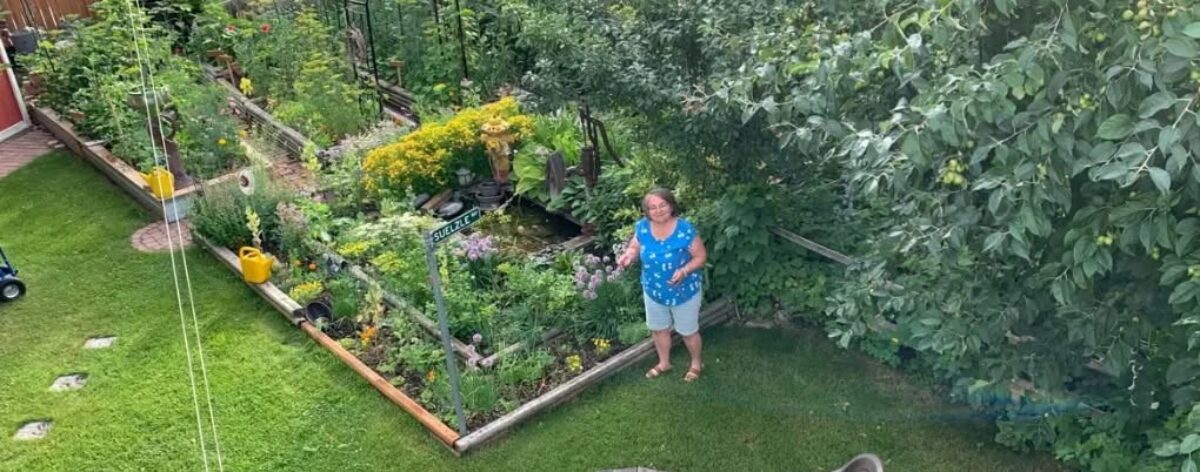
We planted flowers in our sunny front, as well as strawberries, herbs and pole beans strung to cover our southern window and shade our living room from the heat of the day. We planted vegetables in Dan’s mom’s nearby backyard garden. I came across a quote in those early months that helped me. “Let everyone sweep in front of his own door, and the whole world will be clean.” by Johann Wolfgang von Goethe 2 – an 18th century German “Influencer“. I took it to heart. I understood it to mean that I had a responsibility to make the world a better place simply by caring for and beautifying the areas I have control over – my “front door step” as it were.
Spencer W. Kimball, another INFLUENCER who influenced me greatly in those early years, was more specific. “Even those residing in apartments or condominiums can generally grow a little food in pots and planters. . . . Make your garden neat and attractive, as well as productive. ”
With this philosophy in mind, personal environmental stewardship becomes more than an idea—it becomes a responsibility. It rests with each of us to protect and conserve natural resources through the choices we make every day.
“Doing our part” isn’t just a phrase; it’s a series of small, meaningful actions—conserving water and energy, reducing waste, choosing more sustainable ways to get around, and supporting the health of our local ecosystems. Individually, these efforts may seem modest, but together, they shape the kind of world we leave behind.
What can WE do at home that will affect the environment?
Drawing on Johann Wolfgang von Goethe’s philosophy, “Let everyone sweep in front of his own door…”, we are reminded that meaningful change begins with personal responsibility. The small, intentional steps we take each day may feel like minor inconveniences, but they matter.
Individually, they may seem insignificant; collectively, they have the power to create real, lasting change. How many of these action steps listed below are you already employing? Which ones can you improve on? Which ones are you willing to commit to?
Energy and Water Conservation:
- Switch to energy-efficient LED light bulbs and energy-efficient appliances.
- Use a clothesline in warm weather instead of a dryer.
- Adjust our thermostats for heating and cooling to be more moderate. Put a sweater on, wear slippers.
- Unplug electronics, computers, and chargers when not in use.
- Take shorter showers and fix leaky faucets promptly.
- Mulch in the garden to reduce the need for watering.
Waste Reduction and Management:
- Make “Use it up, Wear it Out, Make it Do, or Do Without” your household motto. The chic new way of saying the same thing is: “Reduce, Reuse and Recycle“. Who knew thrift would ever be ‘cool’?
- Reduce the things your household consumes that include excessive or single-use packaging.
- Reuse shopping bags, water bottles and other materials. Compost food, garden and yard waste.
- Recycle when appropriate.
Sustainable Transportation:
- Walk, bike, use public transit or carpool when possible, instead of driving.
Sustainable Food Management:
- Grow more of your own fruits and vegetables. If this is new to you, LEARN how, by taking classes and attending workshops in your community.
- If your yard isn’t sufficient, join a community garden.
- Learn how to preserve what you grow, to extend it into the cold months.
- Reduce food waste by shopping in your fridge and freezer more and eating out less.
- Compost kitchen scraps to use as natural soil builders and fertilizers.
- Volunteer in your community garden, charitable organizations, and food bank.
- Volunteer with your community league to protect natural areas, create pollinator parks, and encourage urban gardening and habitat restoration.

We all share a responsibility and an accountability to improve the places we call home. It begins right at our own front door—by caring for what we can see and influence—and then slowly extends outward.
We may find that our efforts inspire others to do the same, creating a quiet ripple of change. But even if they don’t, that isn’t the point. What matters is staying true to our own conscience, choosing each day not to be part of the problem, but part of the solution.
Stewardship plays a vital role in shaping sustainable relationships between people and nature—especially in rapidly growing urban landscapes like our own.
Reach out. Be a good neighbour. Take care of what you can see from your own front door, and then go a little further. Get involved. Volunteer. Support the good things happening around you.
Make the world a better place simply because you are in it. And above all, find joy in the doing. When you approach it with a willing heart, your attitude begins to shift. You find more reasons to smile, more moments to appreciate—and, in ways you might not expect, life becomes richer for it.
I’d love to hear your experiences and thoughts.
Cindy
- “No man is an island, entire of itself. Every man is a piece of the continent, a part of the main. If a clod be washed away by the sea, Europe is the less. As well as if a promontory were. As well as if a manor of thy friend’s or if thine own were. Any man’s death diminishes me, because I am involved in mankind. And therefore, never send to know for whom the bell tolls. It tolls for thee.” John Donne ↩︎
- Johann Wolfgang von Goethe, a German writer and natural philosopher, was born Aug. 28, 1749. Goethe is best known for his literary works, such as The Sorrows of Young Werther (1774) and Faust (1808 and 1832). Goethe also saw himself as a Naturforscher, an investigator of nature. ↩︎