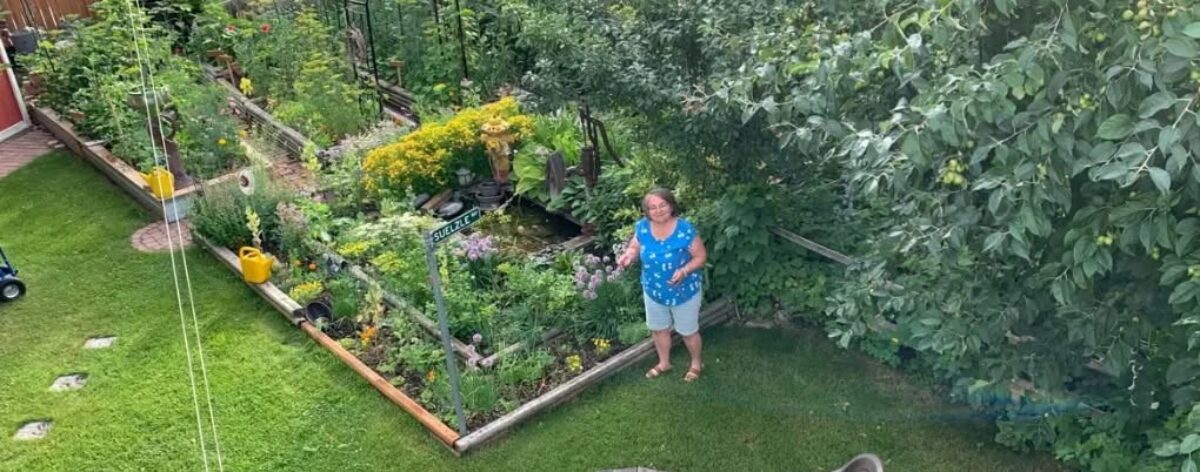
Even if you’re a first-time gardener, you’ve likely discovered by now that gardening is not simply a matter of planting seeds and watering them. Nor is it as straightforward as planting in the spring and harvesting in the fall. Gardening asks for patience, attention, and a willingness to adapt—especially when nature has plans of its own.
This year has certainly proven that point. Edmonton has just experienced the wettest June in recorded history. The previous record, set in 1914, saw 217 millimetres of rainfall. That record was surpassed well before the end of the month, reaching 262 millimetres by Sunday, June 28—and that doesn’t even include the additional rain that fell on June 29 and 30. (At the time of writing, the evening of June 30, the final total is still climbing.)
While I’m sure that one day we’ll look back on this and even brag about it, right now it’s a record we would have been just as happy not to set. Everyone knows someone whose basement has flooded. Newly planted trees are quite literally floating. And it has created enormous challenges for farmers and gardeners of every kind.
Challenges We’re Seeing in the Garden:
Root Suffocation and Rot
Edmonton’s clay-rich soil drains slowly. When water lingers, it displaces oxygen in the soil, causing roots to literally suffocate and, in many cases, develop rot.
Nutrient Loss
At best, excessive rain leaches away essential nutrients—especially nitrogen—leaving plants looking pale, weak, and stunted.
Fungal and Bacterial Diseases
Constant moisture creates the perfect environment for disease. Splashing soil can carry fungal spores onto lower leaves, leading to issues like powdery mildew, black spot, and various blights.
Pest Surges when the flood dissipates
Beyond the mosquitoes we’re all battling, wet conditions also invite an increase in slugs and snails, which can quickly damage tender plants.
Every experience is an opportunity to learn—especially the ones we wish we never had.
Here’s a foundational truth: we will never become good gardeners if the weather is always perfect. And the next truth is just as important: the weather is never perfect.
When I managed our family businesses, and later taught at annual industry conventions, I encouraged people to ask themselves three simple questions after every event—big or small. I’ve found these questions helpful in every area of life as a way to reflect, learn from both good choices and mistakes, from successes and failures, and to continually improve moving forward::
- What went well?
- What could I have done better?
- What did I learn?
So let’s bring these questions into the garden:
- Under the circumstances, what am I glad I did? What was working?
- Is there something I could have done that would have made this better? What was it?
- Where do I go from here? What did I learn—and what will I act on to ensure a better outcome next time?
From this month’s excessive rain, there is much we can take forward—not just for the rest of this season, but for all our gardening seasons to come.
If you and I have ever talked gardening, you’ve probably heard me mention no-till gardening. If you were to look at my plot in the community garden, you’d notice one thing right away: lots of mulch. I admit, in the beginning (several years ago), the appearance took some getting used to. Like most, I was used to seeing the standard black soil. Nice, clean black soil, in a perfectly flat garden. Now I try to have as little bare soil showing through as possible, preferring a generous layer of mulch and no flat ground.
I sculpt out rows that sit noticeably higher than the surrounding ground, using the excess soil from paths that are set much lower. You’d also see that my rows are mulched with straw, while the paths are deeply covered with wood chips.

Though this method of gardening is often promoted as protection against drought, it works just as effectively in the opposite extreme.
By keeping the paths lower than the rows, excess water is naturally diverted into these “ditches,” moving it safely away from tender plants growing in raised mounds. These rows—often planted with multiple lines of vegetables—stay elevated and better drained.
Heavy mulching plays a dual role. Straw on the rows helps retain moisture when it’s needed, while wood chips in the paths encourage water to move downward into the soil, where it remains accessible to deep, searching roots. At the same time, both types of mulch help prevent rapid evaporation when the sun finally returns.
Advantages of Raised Rows
- Slightly Warmer Soil – Ideal for seed germination, especially in early spring.
- Improved Drainage – Plants sit above water collection areas and are never left standing in puddles.
- Healthy Soil Structure – Undisturbed soil supports a thriving ecosystem, creating natural air pockets and allowing moisture to move freely.
Advantages of Straw Mulch on Rows
- Temperature Regulation – Insulates soil, keeping it cooler in heat and warmer in cold.
- Moisture Retention – Acts like a “lid” on the soil, reducing evaporation.
- Weed Suppression – About 6 inches is ideal, but in smaller urban gardens, that is sometimes not possible. Less when neccessary, still makes a significant difference. Use as much as you can.
- Soil Protection – Prevents “sunburn”1 of the soil and protects the living ecosystem beneath. Yes, ‘sunburn for soil’ is a real thing. See the footnote below.
- Builds Soil Over Time – As it breaks down, it becomes compost, creating rich, healthy loam.
Tip: Add straw each fall to build a living, breathing soil system year after year.
Advantages of Wood Chip Mulch in Paths
- Water Management – Provides a place for excess water to go, allowing it to spread out and soak in—away from plants, but still accessible to roots.
- Moisture Conservation – In dry conditions, wood chips help retain water by reducing evaporation.
At Sakaw Garden, we try to keep extra straw on hand for anyone who would like to use it. Personally, I prefer chopped straw—especially in smaller garden spaces, where it’s easier to handle and apply evenly.
How do we chop it? The old-fashioned way. Dan and I have brought a lawn mower down to the garden, spread out a few bales in the field outside the fence (before the dandelions flowered), and mowed over them. We gathered the chopped straw into a wheelbarrow and brought it into the garden for use. Pretty simple and straightforward.
The first time we did this, Dan mowed many bales and left a generous pile just outside the east fence for others to use. These days, when all I need is to top up, I’ll often just bring a large bag from home that we’ve already chopped.
I strongly and wholeheartedly recommend the no-till method: raised rows, deep paths, and plenty of mulch. It’s a simple, resilient system that works with nature—whether we’re facing drought… or the wettest June on record or something in between.

All are adversely affected by the rain, but while plots 1 and 3 are flooded, the middle one is not. The difference?
From time to time, over the last couple of years, Gardener #2 has raised her wooden frame just enough to accommodate the additional material she’s been adding: compost, soil and mulch. She’s customized the spirit of no-till gardening and applied it to her 10×10 foot plot. She has a single recessed path in the middle from which she can reach her planted areas. She’s mulched it with straw, diverting all excess water into it. Meanwhile, she’s been gradually adding compost to her growing areas, resulting a garden that is winning in the Edmonton rain-wars of June 2026.
This quote from Maya Angelou is in two prominent spots in my home as a constant reminder to me. It is my personal mantra.

I find its message both liberating and motivating at the same time. The principle is simple: to forgive myself for past mistakes, recognizing that I did the best I knew how at the time—while gently encouraging myself to learn from them and do better moving forward.
Gardeners, this too shall pass. Maybe quicker than we might imagine at the moment. And with it, perhaps the best learning experience we’ll ever have will pass too. Let’s not waste this frustrating experience by NOT learning from it.
There is no end to learning. Commit to ‘keep on keeping on’.
Warmly
Cindy Suelzle
Footnotes:
- SUNBURN: The sun’s intense UV rays and heat can heavily degrade soil. In Alberta’s usual dry climate, harsh sunlight and hot temperatures can bake topsoil, kill vital microorganisms, and cause rapid moisture evaporation, which turns exposed dirt into cracked, dusty crust.
To prevent sun and heat damage to your Alberta soil, use the following actionable tips:
Apply a Thick Layer of Mulch: Covering your soil with a minimum of 3 inches of organic mulch (like wood chips, bark, or straw) shields it from direct sunlight, insulates it against extreme temperature swings, and protects it from rapid evaporation.
Add Organic Matter: Incorporate compost into your flowerbeds and vegetable gardens. This improves soil structure and water retention, allowing it to better handle our ‘usual’ blazing prairie sun.
Water Effectively: By mulching, you will eliminate the need for watering as frequently as you did in the past, but when you do, water your soil early in the morning. This minimizes evaporation and ensures that the moisture absorbs deep into the soil before the peak afternoon heat hits. ↩︎