Simple things that can make a difference when its all about what YOU can do at home. An onion chest poultice is an old folk remedy that is often still used, because it is surprisingly effective. Among other good things, onion contain sulfur compounds that help fight mucus and promote the expulsion of mucus from your airways. Onion and its even stronger cousin garlic, are powerful natural antibiotics as well as being antiviral and antimicrobial. This makes them valuable for viral and bacterial infections. So yes make a poultice which will soothe from the outside, and that you’ll be able to inhale, but don’t forget to EAT them as well. Let them work from the inside too.
I love how Wendi talks about using fresh onions, but in the absence of them she shows us how to use dehydrated onions. This is so important and like her, I rarely have fresh onions in my house anymore unless they’re in my garden for the few months I can grow them, and maybe a few months after harvesting. I do keep dehydrated onions, but for the most part – I choose to use THRIVE LIFE freeze dried onions for most of the year. They come diced or sliced, and are always ready to use in all my favourite dishes. As with all Thrive Life fruits and vegetables, they’re flash frozen within only a few hours of harvest, sealing in all their natural nutritional goodness. This is very important to me. All the benefits of ‘fresh’, but easier and much more convenient to use, and with a shelf life of 25 years. That’s very important to me, because I’m all about long term food storage. Even after opening, we have at least a year to use them, depending on humidity in your area.
Wendi Bergin, the Joyful Prepper
These two pungent herbs (onions and garlic) are probably best known for their immune enhancing properties, but that’s another topic for another day. Many folk remedies suggest sleeping with onions wrapped onto the bottom of your feet! Don’t laugh. And don’t be too quick to discount things that seem too simple or even silly at first glance. In fact, garlic and onions contain anti-inflammatory chemicals that have been shown to relieve some forms of arthritic pain. Onions are a rich source of flavonoids, one of which – the antioxidant ‘quercetin’, has been shown to inhibit inflammation-causing leukotrienes, prostaglandins and histamines in osteoarthritis and rheumatoid arthritis. Yeah, I had to look them up too – lol.
Q: What are leukotrienes? A: chemicals your body produces, especially when you come into contact with something you’re allergic to. As a form of protection, they can cause coughing. build up of extra mucus and fluid in your chest and throat, as well as inflammation or swelling in your airway.
Q: what are prostaglandins? A: fatty acids made at sites of tissue damage or infection caused by injury or illness. They control processes such as inflammation, blood flow, the formation of blood clots and the induction of labour.
Q: what are histamines? A: chemicals your body makes to help expel allergens from your body through symptoms such as a runny nose or sneezing.
While we shouldn’t want to get rid of these natural protective functions completely, they can cause a lot of discomfort. Wouldn’t it be nice if there was something natural and ‘normal’ you could eat, that could assist in alleviating the worst of those symptoms though?
Let Food Be Your Medicine
Onions are members of the allium family, which includes hundreds of species, and they are one of the most widely used vegetables/herbs in the world, with some types growing in every climate except the arctic. Ones we’re more familiar with are the ‘onion’ of course, garlic, scallion, shallot, leek, green onions and chives. And even among these, there are many, many different types, each with its own special personality and qualities. In North America, the most popular onion to purchase is the yellow onion, for its long lasting quality. Named for its outside colour, not inside, it is cured (dried outside after harvest). If kept in a dry dark, semi cool place, it will last for months.
there are so many different types of onions, that could almost be a food group unto themselves.
They are a good source of nutrients and are known to offer a plethora of health benefits – many more than what we’ve reviewed here. Onions are a tremendously rich food source of flavonoids, in particular, the antioxidant quercetin (see above), which is known to prohibit the activity or creation of cancer-causing elements. A quercetin-rich diet is a recognized good defense against developing cancer.
Make onions more a part of your life.
– If you’re one of those people who don’t like the texture of onions, use freeze dried – they’re better than any alternative we can buy at the grocery store anyway.
– If you’re one of those people who don’t like the taste of onions, get over it and find a way eat them anyway. They’re really good for you. They’ve proven themselves enough times to be taken seriously, figure out a way to incorporate them into your daily diet. Hide them, disguise them if you must, but definitely EAT onions. Thrive Life’s freeze dried onions will help immensely with that.
– If you’re one of those people who have kids who think they don’t like onions, be the parent and find a way to use them anyway. If you need to hide them, then hide them! But use them! Thrive Life’s freeze dried chopped onions will become your new best friend.
Okay, its not possible for any food to have only good things said about it. I think we all know the one downside, and it has something to do with ‘the smell’. Not just the smell of onions, but the smell of ‘us’ after we eat them. Onions contain organic sulfur compounds, which are the reason onions have such a sharp, strong taste and smell. Yes, those sulfur compounds help reduce the level of cholesterol in our bodies, breaking down blood clots and lowering our risk of heart disease and stroke. BUT, those same sulfur compounds cause the only negative effects from eating onions – irritation to eyes when cutting, and body odor.
When our bodies break them down, those sulfur compounds react to sweat on our skin, creating what is generally considered to be an unpleasant odor. In our society, that’s a considerable downside. And in some individuals with IBS (irritable bowel syndrome), they may increase gas and bloating. Small price to pay in my opinion, but I have found that freeze dried onions do not seem to create the same problems. As far as the tearing up aspect, try rinsing a peeled onion under water or chill it for 30 minutes before cutting. Or of course, you can skip the whole chopping step, and go straight for the freeze dried option.
As far as the onion poultice – this is new to me. I’m happy to know about it and appreciate Wendi’s thorough instructions. I have everything I need on hand and will take her advice to set aside some more clean, white cotton for that purpose.
Have you ever tried an onion poultice? Or any other type of poultice? I’d love to hear your opinion and your experience.
In the name of family and of all that is good in this world, we have this beautiful, tender scene painted by Robert T. Barrett – of two brothers embracing. It is a scene of forgiveness, and one of a shared bond that was ultimately stronger than differences. After two decades of separation, caused by two opposing perspectives, offence given and offence taken, misunderstanding and vengeful anger, they come together on a field that could have just as likely, been a bloodbath. Every reason to hate still valid, because though a lifetime had lapsed, the facts still remained. The ball was in Esau’s court so to speak, he could have gone either way. He may have even been uncertain himself, after all he came out to meet Jacob with 400 men. But there. On that field. After long absence, and tremendous mutual familial loss, including the death of their mother in Jacob’s absence, we see one of scripture’s great lessons on forgiveness.(1) Esau let go. There was no chance of bringing back what was lost, nor of undoing what had been done, and to persist in a attitude of vengeance would only cause further hurt and further loss.
Esau and Jacob Embrace by Robert T. Barrett
At what point does one say “Enough is enough. And this truly IS enough!” ? Does it take a year? a decade? more? A veritable lifetime of separation? Does it take the death of a parent? Wherever that point was for Esau, he had reached it and crossed over. And though Rebekah did not, Isaac lived to see it. I can scarce imagine the gut wrenching sobs and father-tears of both grief and joy to hear the news and to feel with his very own hands (for his sight had long ago failed him), both of his boys at the same time. I’m sure he had all but given up hope that he ever would.
Such a reunion! And how could Rebekah not have looked on with similar emotion from her heavenly vantage point? Brothers. Sisters in law. Cousins who never knew each other. Each family had followed a different path, and their futures wouldn’t necessarily be intertwined, but old grudges were gone and peace could once again prevail, as they parted ways, this time with mutual acceptance and respect. “That’s what its all about, ” says singer songwriter Sam Payne “Having good reason to hate each other and not hating each other anyway.” (2)
Most of us can pull an Esau-Jacob story from our family files. Maybe they ended well, maybe they have not yet. For me, I have a few. Some are not quite completed. One saw resolution many years ago, and has gone on to yield life long loving familial relationships, and eternal blessings not even imagined before. My dad came from a large family of sixteen natural born children. Fourteen of those children grew to adulthood and had families of their own, and yes, you’re right – that makes for a lotta cousins for me. When I was very young, we lived many hours drive from my grandparents. We generally saw them once a year. But my Harrison cousins, many of them also lived many hours drive, and I saw them seldom. We had our very first “Harrison” family reunion when I was in elementary school. In Waterton park. I was shy around so many aunts and uncles and cousins. I had a brief but memorable exchange with one cousin from far away during that reunion. I didn’t know how we fit together, but the adults told us we were cousins, so we played. Her name was Jerilyn. We were the same age and we shared the same last name because our dads were brothers. We had been playing together for a time when her family got ready to go on a planned outing; she invited me to come with them. I’m not sure what motivated me to accept, as they were virtual strangers and I was very shy, but I did, and my mom consented. Her dad was an anomaly to me. He was soft spoken and kind. He laughed – with children! He genuinely seemed to want to be with them. He spoke to me directly. He told dad jokes and my cousins were easy and comfortable around him. My memory of that event is brief, and would have faded altogether I believe, had it not been for a converging of our two families only a few short years later.
Sometime in my childhood, whether before or after that reunion I don’t know, my father had been sent to Winnipeg on an assignment. He was in the Royal Canadian Air Force (as it was called then). While there, he was invited to dinner at his brother’s house. This same brother, who also served in the Air Force. My dad was a couple of years older, both in their mid 30’s. By all accounts, dinner went well. I’m sure it was delicious – my aunt was a good cook. I’m sure my cousins were well behaved, there were 4 of them. All girls. After dinner, my dad pulled out a cigarette as was the habit of smokers. It was no secret that he smoked. Most adults did in those days, certainly the ones in my world. Whether it was my aunt or my uncle who asked my dad not to smoke in the house, is unclear, but my dad attributed it to Aunt Jolayne. He went outside on the front porch to have his cigarette. It was winter. He might have been mildly annoyed at first, but as he stood there smoking, he became increasingly annoyed – even offended. It is so common for people to not smoke in homes nowadays that it may be difficult to imagine a time when it was not only acceptable, but very common. My dad was easily offended at the best of times, so this was the perfect opportunity to do what came naturally for him. As he blew smoke out, he became quite indignant at having to do so outside. In the winter no less. And he walked away. Building up a defensive wall with every step. He had been insulted in the house of his brother. Offended. Never would he darken his door again. My uncle’s wife had insulted my dad, and by association, so did he. They were intolerant and inhospitable, and judgmental, and rude. The extent of the perceived offence grew as the distance between them grew. I can only imagine what that may have felt like from the perspective of my aunt and uncle inside the house. Especially if they watched my father walk away. They had all been raised in southern Alberta “Mormon” towns, in Mormon families. Both families lived by the tenants of their religion and keep the word of wisdom – which included abstaining from tobacco, alcohol and tea and coffee. My dad was one of the brothers who deviated from the family religion.
Distance and time created more distance and time, and as sometimes happen, the wound festered. You could say it had even become infected. I didn’t know my aunt and uncle, and I didn’t know this story, until when I was ten years old we learned that they were moving to our base. My uncle Merlin had been transferred to the airforce base in Cold Lake, Alberta. As children, we couldn’t even imagine what having cousins live so close might be like. My parents did not seem happy about the news, so we were filled with concern, but secretly, I was just a little excited at the possibilities. The old wound however resurfaced, and if we had missed it before, we understood more fully now how significantly bad it was. I didn’t even know what my Aunt Jolayne looked like, but I knew she was a “religious fanatic“. I knew she kicked my dad out of her house for smoking. On a winter day! Smoking in my world was like breathing. Every adult did it. Her action was unimaginable and there was no question that it was unforgiveable. We prepared for the worst.
My uncle came ahead and lived temporarily in the barracks while he waited for a PMQ, and for his family to arrive. One night we invited him for dinner. My dad wasn’t home, so my mom and I went to the barracks to pick him up. We shared a meal with this stranger who we knew was our uncle, and he was . . . nice! And kind. He brought us gifts. Hot chocolate mix, something we had never seen before. All four of us got our very own, which my mom protested was too generous, but he insisted and we were very happy. He was complimentary of the meal, and spoke easily with all of us, even directly to us kids. He asked about our interests and school. We didn’t know how to take him – I had not taken note of too many times in my life that an adult other than a teacher, had spoken directly to me, let alone being interested enough to listen to my response. After dinner, he sat at the table with me as I did my homework. I was writing some kind of report about the pyramids in Egypt, using our ‘Book of Knowledge’ encyclopedia. He told me he had been to Egypt! He had seen the pyramids, the very ones in the picture we looked at. I had never met another man like him in all my long life of ten years. I went with my mother to drive him home and listened to them chat in the front seat. When he got out of the car and waved goodbye, I said to my mom “I like him.” She said “I like him too.”
Sometime after that dinner, Uncle Merlin’s family arrived. They came to visit us and we may have had supper together. We cousins became acquainted with each other. I showed my cousin Shawna my guitar, and played her a song I was learning. Having cousins live in our community was such a strange idea. They would even be coming to our school!
When they got settled in their new house, they invited us to dinner. We were all familiar with “the story” by then, and we wondered how it would play out. We were not just a little apprehensive, and I seem to recall my mom reassuring my dad that all would be well, and that he could suck it up for one evening. After all, he had sworn to never go there again. It was . . . our field. And quite literally, it was our Esau and Jacob moment. Though our two households had had touch-points, we had never as a family, been in their ‘home’. We went, my dad – less willing and still carrying his comfortable crutch – a ‘grudge’. He had after all, been offended, and that could not be forgotten, nor set aside.
When we arrived, they met us at the door and welcomed us in. My aunt Jolayne handed my dad a clear, glass ashtray, purchased for this occasion. She told him “Wes, you can smoke in my house any time you want.” To this day, I cannot think of that single gesture without weeping. I don’t recall my dad’s response, but on the drive home, he said to my mom “Well, if that doesn’t beat all. All these years, she hasn’t forgotten. It has been eating at her like it was eating at me.” He affirmed that never in this life, would he be disrespectful enough to smoke in Aunt Jolayne’s house, but that thoughtful gesture skyrocketed her in his esteem. His dislike transformed almost instantly into admiration, even respect. And over the years that we both lived in Cold Lake, it evolved into love. We spent many happy hours in the company of Uncle Merlin’s family. My dad was a better dad in his brother’s company. Without being too dramatic, it set the wheels in motion for not only life altering changes in my life, and life long friendships between our households, but eventually, the sealing of our family as an eternal unit. That is another story for another time. A story of my utter love and gratitude to Uncle Merlin’s family, and for all that came from the seemingly insignificant gift of a small glass ashtray.
Destructive conflict is “when our inability to collaboratively solve problems with others leads us to hurting others or ourselves.” so says Chad Ford, Professor in Intercultural Peacebuilding at Brigham Young University-Hawaii. “With destructive conflict comes a fear of pain both in anticipation and as a consequence of the conflict, a fear of not being loved or seen the way we want to be seen . . . .” (3) Though our dislike of someone who has offended us may devolve into hatred, hopefully it doesn’t de-escalate to the murderous level Esau’s did. He had sold his birth right to Jacob for a bowl of lentil soup (see Genesis 27: 6-29). At the time, he didn’t have proper respect for the value of his inheritance, and when the time came that he had to own his choice, and live with its consequence, he hated Jacob. So great was that hate, that he swore to kill him. Knowing the violent propensity of their elder son, both Jacob’s parents encouraged him to leave home and to travel to the distant land of his mother’s people – where he could not only find temporary refuge, but also find a wife among believers of the one true God. For two decades, Jacob lived among his mother’s people, marrying two of her brother’s daughters, and accumulating for Laban (his father in law), great wealth by his industry and the blessings of God. Laban recognized that God was with Jacob. At length, God directed Jacob that it was time for him to return to Canaan, the land of his inheritance, which in conference with his wives, he set about to do.
As they travelled and neared the place where he grew up, Jacob worried about Esau and his murderous grudge. He prayed for help. “Deliver me, I pray thee, from the hand of my brother, from the hand of Esau: for I fear him, lest he will come and smite me, and the mother with the children.“(4) He sent notice announcing that he was coming home. His servants returned, telling Jacob that they delivered the message and that Esau was in fact coming out to meet him. With four hundred men! – a veritable army. Rightly fearing his brother’s intent, Jacob separated his company into two groups, reasoning that if Esau attacked one group, the other would have time to escape. He separated generous gifts and sent them ahead with instructions to graciously deliver them to his brother, hoping to communicate his desire to reconcile before they met face to face. Unbeknown to Jacob, Esau may have already reached his peace. Whether Esau had forgiven him before that day, or whether it was a gradual transition, softened by the demonstration of good faith as he was offered generous gifts, we’ll never know – and he himself may not even have known. And it doesn’t even matter. What mattered was that he allowed the gesture to touch his heart, and he was softened to his brother. (My dad was softened toward his brother and sister in law, but it wasn’t until the gift of the ashtray, that he finally allowed the sweet spirit of charity, the gift of final forgiveness to take hold and sooth all that had passed – never to be revisited except to recount a happy outcome.)
Brother’s Road by singer songwriter Sam Payne
When they came within view of each other after so long, Jacob prostrated himself respectfully, and was no doubt surprised that “Esau RAN to meet him, and embraced him and fell on his neck and kissed him; and they wept.“(5) What a glorious scene! Can anything be more beautiful than unresentful reconciliation, powered by true and open forgiveness, a letting go of a former grudge? Who cares what past offense fueled it? In this beautiful story, we see the example of truly “letting go”, of genuine and sincere forgiveness. Of charity in its truest form – which scripture defines as the pure light of Christ. “Deciding to love those who could hurt us allows us to push past fear and become filled with charity.” says Chad Ford. “Love allows us to see our brothers and sisters we are in conflict with, so clearly that THEIR needs and desires matter as much to us as our own . . . . We’ll do whatever it takes to find solutions that meet their needs as well as our own.” (6)
“It took courage for Jacob and Esau to acknowledge the truth that they were not enemies – they were Brothers. It took mercy to forgive each other. It took righteousness – the kind of justice that makes right what we or others have made wrong. . . . When all three of those elements were present, it allowed them to live in peace.” (7)
We all have our Esau and Jacob moments. Offence is given and offence is taken. It’s unavoidable, part of our mortal experience. Perhaps they are within our own family. Perhaps they are between neighbours, former friends, or colleagues at work. It never matters which character in the story we play, but the script is usually recognizable. When we are in destructive conflict we justify our behaviour and our feelings. We rationalize that we are in the right, and that no right-minded person could see otherwise. If they try, we firmly place them in the opposite camp. We may villainize the offender, refusing to empathize with them or the situation. We may rally our troops to try to “infect” others with our intolerance of the offender, and their great offence against us. We in fact, do not want to see their side. We do not want to forgive, or to extend ‘mercy’. We crave only justice, but not justice for all, only justice for us.
We cannot start the process of reconciliation without Courage. I cannot imagine the trepidation that my aunt must have felt in trying to make peace for an offence she didn’t willfully intend, but nevertheless perpetrated. We cannot proceed without Mercy. We must try to see the situation from the perspective of the other person. We must try to FEEL it the way they feel it, without trying to explain away or minimize our own part in it. Mercy requires Empathy. And we cannot sustain it without a commitment to continued Righteousness in our chosen path of reconciliation. We cannot truly ‘let go’ without a change of heart that we are committed to. True forgiveness never goes back. To experience the lasting effect of that sweet spirit of final forgiveness, is to never revisit it, “except to recount a happy outcome“.
The picture at the top – Esau and Jacob Embrace by Robert T. Barrett, spoke to my heart. When I first saw it, I saw a powerful story. One of the world’s great stories of forgiveness. A story of siblings who were angry with each other, and felt justified in their resentment. Insults were given and received – whether accurate or magnified doesn’t even matter; they were real enough to them. I saw the inability or refusal to feel empathy, and of course, the resulting offences. All. Let. Go. On that field. Symbolized by a long, tearful brotherly embrace. They say a picture is worth a thousand words, and it was to me. As a mother that is my wish, my hope, and my daily prayer. That unlike Rebekah, I will witness such an embrace, and I won’t have to wait to do so from an other world’s vantage point.
I’ve read many different perspectives on the story of Esau and Jacob. Some paint Jacob as ‘the deceiver’. Some paint Rebekah as the conspiring accomplice. Some paint Esau as a brute who was outwitted. Some paint Isaac as a puppet. All those are short sighted and one sided in my opinion, too easy to judge people of antiquity by the ‘woke’ standards of our day. The story is complex with many layers that would take volumes to discuss. My point here is only to get to the core of what matters most: unconditional love. True ‘Charity’. Moroni says “if ye have not charity, ye are nothing, for charity never faileth.” He says that charity “is the greatest of all, for all things must fail— But charity is the pure love of Christ, and it endureth forever “. (8)
I’d love to hear your thoughts.
Warmly,
Cindy Suelzle
footnotes: 1. Genesis 25-35 2. introduction to Brother’s Road, youtube live video 3. Liahona magazine March 2022 pg 26 4. Genesis 32:11 5. Genesis 33:4 6. Liahone magazine March 2022 pg 27 7. ibid pg 28 8. Moroni 7: 46,47
Tomatoes are nature’s most potent source of lycopene. What IS lycopene and why do we care? Lycopene is a powerful antioxidant with many health benefits, including sun protection, improved heart health as in lower risk of stroke and heart disease, as well as a lower risk of certain types of cancer. It is most effective when consumed in the form of lycopene-rich foods like tomatoes and other red or pink fruits. Studies indicate that lycopene reduces bad cholesterol (LDL) while increasing good cholesterol (HDL) levels. This balance is important because high cholesterol develops fatty deposits in our blood vessels, which can clot and lead to a heart attack or stroke. Remember, RED foods are good for the heart.
it is difficult to think anything but positive thoughts while eating a homegrown tomato
And now, you’ve got all that natural tomato goodness in a concentrated form right in your pantry! I know right? Who could have imagined that now you can: STOP buying those little 6 oz cans of tomato paste that you never use all of anyway STOP buying canned tomato sauce (in all their varieties) STOP buying tomato juice Because you’ve got all three of these wonderful foods right here in powdered form (just add water). And its a lot more nutritious because it hasn’t gone through the high temperatures of canning (which only retains 40% at best of the nutritional value). Tomato Powder is a super useful food to have on hand in the kitchen at all times. I can’t speak to all tomato powders, but Thrive Life Tomato Powder has a strong, clear tomato taste, like you just picked a ripe tomato out of your garden! It’s got all that wonderful natural tomato acid, because . . . . . . guess what? The ingredient (yes, that’s singular) is: TOMATOES. That’s it. The only thing in the can – is tomatoes. No salt, sugar, colours, flavour enhancers, or other additives of any kind. You can add your own salt to taste. Or not. You do you.
Making your own TOMATO POWDER
drying your own tomatoes for tomato powder
Making your own tomato powder is pretty straight forward. A little investment in the time department, but easy, and if you’ve got an excess of garden tomatoes, its a great use for them. Best practice is in a dehydrator, but you can dry in a slow oven, and if you live in a hot dry climate, you can dry them in the sun. I don’t – so that’s all I’ve got to say about THAT.
The meatier type of tomatoes is preferable, as they have less water and less seeds – like Romas. Simply slice and lay evenly in your dehydrator. All dehydrators might be different, but select a low setting and expect it to take a full day and night. How long exactly, depends on too many factors to estimate with any precision. Factors like: type of tomatoes you are using, and how much water they contain, how thick you sliced them, even the weather – is it cold and rainy, or hot and dry?
You’ll want to continue to dry them until they are brittle. Ensuring that you have removed all the moisture is critical to give you a good product in the end. Use a food processor or blender to grind the tomatoes into a fine powder. It may be helpful to break the tomato slices into smaller pieces as you add to the blender. You can sift the powder through a sieve to separate the larger pieces, which you can put back into the blender.
Store in an airtight container in a cool, dry place. Nothing lasts forever, so plan to use it up in a year (or two at the most). Nutrition will diminish over time of course. Having it be VERY dry in the beginning is key to it staying dry, and it STAYING dry is key to longer shelf life. Keep it well sealed, as it will want to absorb the moisture from the air.
tomato powder on right, tomato skins powdered on left
10 WAYS TO USE TOMATO POWDER
1. Tomato paste ratio 1:1-2 1/4 cup tomato powder + 1/4 cup water = tomato paste start with the lesser amount of water, and then add a tablespoon more at a time to reach the consistency you prefer
2. Tomato sauce ratio 1:4 1/4 c. tomato powder + 1 cup of water = 1 cup tomato sauce
3. Tomato juice ratio 1:8-10 1 T. tomato powder+ 1/2 cup (8-10 T.) water optional: add your choice of seasoning ie: onion powder, sugar, salt, pepper, to taste
4. Spaghetti sauce ratio 1:4
or use your own Mediterranean seasoning mix: any combination of oregano, thyme basil, rosemary, garlic, onion,
5. Pizza sauce ratio 1:3
or use your own Mediterranean seasoning mix: any combination of oregano, thyme basil, rosemary, garlic, onion,
6. Cream of Tomato Soup ratio 1:16 Prepare a roux from 1/4 cup butter and 1/4 cup flour over low to med. heat Add 1/4 cup tomato powder – whisk in Add 1 T. chicken bouillon – whisk in Slowly stir in 4 cups of milk, whisking all along to prevent lumps from forming. Simmer over low heat, whisking to combine well, heat thoroughly and thicken slightly. Add more liquid if needed. *optional: I like to rub some Freeze dried chopped onions through a sieve to create onion powder. Nice addition to the soup. *optional: add 1 tablespoon of Italian or Greek blend of herbs, or your own combination of oregano, thyme and basil. *optional: add another tablespoon or two of tomato powder if you want it richer
Thrive Life had the best Tomato Powder ever. They no longer sell to individual homes, so I’ve been on a quest to match it with my own tomatoes. Nailed it.
7. Ketchup 1 cup tomato powder and 3 +1/2 cups water 1/3 cup honey or brown sugar 1/2 cup apple cider vinegar 1 t. onion powder or 2 T Freeze Dried chopped onion crushed to make onion powder 1/2 t garlic powder or 1 T Freeze Dried garlic crushed to make garlic powder 1 t salt + 1/2 t pepper 1/2 t dry mustard pinch of allspice and a pinch of cloves Combine all, and simmer over low heat stirring frequently to prevent scorching – till reduced to desired consistency. Expect it to take 30-45 minutes depending on your preference of thickness. Pour into jar and refrigerate. Expect 2 pint jars. Best to let it sit a day to allow flavours to fully blend.
8. Barbecue sauce 1/2 cup tomato powder 1 cup water 1/3 cup brown sugar 2 T. apple cider vinegar 1 T Worcestershire sauce 1 T soy sauce 1 T mustard 1 clove garlic, minced 2 T FD chopped onion 1/4 t Cayenne pepper (or your favourite dash of hot) or NOT Salt & pepper to taste Mix all ingredients in large saucepan, heat over low and stir 15 or so minutes till slightly thickened. Stir frequently to prevent scorching.
9. to add that beautiful rich ‘tomato’ zest concentrated To any tomato based soup, stew, chili or pot roast – add a tablespoon or two of tomato powder just because YOU CAN! You’ll be surprised at how it richens things up.
10. As a garnish Sprinkle tomato powder over top potato salad, deviled eggs, hummus, even a lettuce and tomato salad. Be creative.
I’d love to hear your experiences with Tomato Powder, and your suggestions for recipes, please comment below.
Two of the most important things to remember about gardening is that 1) there are a lot of ‘rules’ 2) some of those rules should be broken
There are many things about gardening that one has to experience to understand what the rules are there for. There are the things we must learn through experience – but they don’t always have to be your own, we can learn from each others’ experiences too. One of these age old rules in my part of the world, says that we should plant our gardens on the May long weekend (3rd weekend in May). But statistics say that the expected last frost is anywhere from May 1-10. Obeying that rule straight across the board, amounts to a week or more of lost growing time – when there are only an average of 120 (give or take) frost free days in the Edmonton area.
I don’t pretend to be an astronomer or any other kind of expert, but there are some things that simply make sense to me. Consider this: The summer solstice in is between June 20, 21, 22 (so lets just say the 21st). It is longest day of the year – more daylight than any other. The center of “BEST SUN” days. Count back 7 weeks to May 1, and forward 7 weeks to August 9. Those days are going to be the BEST Sun days of the summer right? A reasonable assumption to make. In fact, in Edmonton, on May 1 – 2022 the sun rose at 5:57 AM and set at 9:05 PM = 15 hr 8 min of sunshine. On August 9 – 2022 the sun rose on 6:03 AM, and set at 9:14 PM = 15 hr 11 min of sunshine.
My point? My point is that after August 9, the sun is not as high, and not as present. In fact only one month later, September 9, the sun rose at 6:57 AM (54 minutes later than Aug 9), and set at 8:04 PM (70 minutes sooner than Aug 9). That is 2 hours and 4 minutes LESS sun-time – in ONE MONTH! So yes, those may be frost free days, good time for things to ripen, but the ideal growing time has passed. If we’re planting on May 24, that gives us only two and a half months of best sun days to grow. When we could easily have another month or more.
So, how does one make the best of those high sun, but possibly NOT frost free days of early spring? Answer: Plant earlier. The next obvious question then is this: what can we plant earlier that will not be killed or stunted by those chilly mornings of early spring? Answer: There are many hardy and semi hardy cool weather vegetables that thrive in our growing season. We just need to get to know them and learn to appreciate them. Here are some ‘hardy’ and ‘semi-hardy’ vegetables (and some notable fruits) that you can be growing in the average backyard garden in and around the Edmonton region, and planted much earlier than the May long weekend.
HARDY VEGETABLES can tolerate a hard frost and temperatures between -5 and -10 Celsius
If you haven’t made friends with some of these yet, then open your mind and introduce yourself. They’re not only anxious to make friends, but are extremely forgiving and loyal. Hardy Vegetables include: Brassicas like Broccoli, Brussels Sprouts, Cabbage, Collard Greens, Kale, and Kohlrabi, as well as Leeks, Parsley, Radishes, Spinach, assorted Asian Greens (like mustard greens, bok choi and tatsoi) and Rutabaga. THAT is a lot to choose from, and ALL of them can be planted as soon as the ground is dry enough to work in. If it snows again after planting – no worries, they laugh at snow. I have planted my Spinach seeds the beginning of April, but depending on the type of spring we’re having, I could easily have planted them a week or two early. Its not simply a matter of spinach tolerating the cooler weather, it thrives in it. I’m sure you’ve noticed that as soon as the weather warms up in June, your spinach bolts (goes to seed). These cooler crops don’t like the heat, and they don’t do well in it at all. They are best grown in the earliest parts of spring. In some climates they are winter crops, but not for us in Edmonton LOL. See below for some advice on ‘some’ of these hardy vegetables. I don’t have experience with all of them, but maybe you do. I’d love to hear your opinions and suggestions from your own experience. Please share by commenting below.
KALE: Personally, I am not a fan of growing most brassicas because I’ve lost too many battles with the caterpillars that like them so much, but I make an exception for KALE. Knock on wood, I’ve never had a problem with kale (so far). It’s easy to grow, doesn’t attract pests, and it toughs out the cold weather in both spring and fall. It was a no brainer that we should become fast friends, I just needed to get to know how to use it more in the kitchen. That was the easiest part of all. I pick kale from May through September – a whole season of wholesome green goodness in salads, green smoothies, and everything in between. And it dehydrates beautifully for winter use. What else could I ask for? Depending on the weather, and the the type of spring we’re having, they can be planted outside by seed, as soon as the ground is dry and warm to the touch (anytime from April 1-30). And don’t worry if it snows – they won’t care. You can get a jump on the season by planting young seedlings outside around the 1st of May.
MUSTARD GREENS and other Asian Greens: One of my personal garden rules is to try growing at least one new vegetable every year. I am SO glad I decided to do that many years ago, as I have learned to appreciate all sorts of great vegetables that I never would have any other way. In 2022 I grew Mustard Greens for the first time, 2023 I grew Tatsoi, which I have grown every year since. In 2025 I added Bokchoi. Several years ago I grew ground cherries and tomatillos (both warm weather vegetables) – huge win! I’ve grown them ever since too.
PARSLEY: has been a favourite herb in my garden for years, and occasionally even comes back in the spring – though at best it is still only a biennial, so its best to count of replanting seedlings every spring. But no need to wait till late May, parsley plants can be planted by May 1st for sure. Don’t bother planting seeds outside. They take too long to germinate for that. Either start them indoors in February or early March, or buy your plants from a greenhouse.
SPINACH: is wonderful, and one of the healthiest plants when eaten FRESH (within a couple hours of harvest). It’s leaves are tender and perfect for salads. I used to buy a lot of ‘fresh’ spinach from the grocery store, all year long, but I very rarely do anymore. We know that all produce begins deteriorating nutritionally within the first hour of harvest, and the sad new about spinach is that within four days – it has lost 100% of its vitamin C. I don’t know about where you buy yours, but I can pretty much guarantee that the spinach available in my local grocery store was NOT picked within the last 96 hours! So the very best source of spinach is the one that can it get to your table within only a few hours of harvest. That means its either grown in my garden, or its THRIVE LIFE Freeze Dried Spinach.
The tricky part about growing spinach is that it LIKES COOL WEATHER. That is its great strength as a garden vegetable in Alberta, since we specialize in ‘cooler’ weather. But wait. The convers of that fact implies that it hates hot weather. And it does. When the sun gets real hot, spinach goes to seed (it ‘bolts’ – see below). If you plant spinach around May 24, it will bolt in the heat of late June, and you are very likely to be disappointed. What to do? Plant it earlier.
Its good to know bytheway, that there are several other greens that grow well all summer long without bolting, so it doesn’t have to be “spinach or nothing”. But, back to spinach. Because it’s a cool weather crop, we can plant spinach in the early spring (early to late April depending on the year), when we can take advantage of the long ‘sun’ days that come with the cooler weather of April and May. Ironically spinach wants a nice sunny location, but doesn’t want the heat that comes with the sun, so its the perfect plant to extend your growing season. By the time your spinach has given up in the heat of summer, your swiss chard and other greens are ready to eat!
Is it worth it? Absolutely. If you can get your spinach planted early enough in the spring, you’ll get a beautiful crop that will flourish. Its the perfect opening act to your summer garden. And its a great source of iron, calcium and vitamins A, B, C, and K.
what is “bolting” and what causes it? Bolting is a common response of cool weather vegetables to stresses of summer – temperature stress, day length stress, or water stress. When the plant is in distress, it hastens it’s purpose in life – which is to go to seed. Long spells of hot dry weather may be good for peppers and tomatoes, but NOT good for spinach. Many other leafy vegetables do the same thing. Not much you can do about the weather in summer, so just work with it. Spinach doesn’t want what tomatoes want. So planting it when the days are cooler, and giving it as much cool time to grow as possible will make it happier.
In some zones, spinach might be a good fall crop, but I’ve found that the end of our growing season is too fickle. In Edmonton, the sun is less by the end of August, but the days are still very warm and dry. We could just as easily have snow in October as not, and if we do, temperatures could drop quickly. I’ve tried extending my growing season by planting spinach at the end of August, but experience has shown me I’m gonna have more success in the early spring.
Plant your spinach in rich soil – amended with old manure and/or compost. Keep it consistently moist, but not soggy. Water deeply and regularly. Spinach is a heavy feeder, so sprinkling blood meal around the plant mid growing season will encourage rapid growth of continuous new, tender leaves. Once you see five or six nice healthy leaves on a plant, go ahead and start snipping the larger ones off for spinach salad.
RADISHES and TURNIPS/Rutabagas: I am not a fan of radishes for their roots, but I absolutely AM a fan of their greens! I grow them, but only for their tops. They have a little zip that is great in a fresh garden salad when they’re young – super nutritious – SO worth it. They’re best when they’re young, so start picking early while you’re thinning them out. Once the roots get big, the leaves are not as tender and suitable for salads, but they make a great Pesto. (click here Radish Green Pesto for the recipe)
SEMI HARDY VEGETABLES will tolerate light frosts and temperatures around freezing (0°C)
Semi-hardy vegetables can be planted quite a bit earlier than the May long weekend, but maybe don’t push it too far into April, unless its an especially warm spring. Some great Semi-hardy Vegetables include: Beets, Carrots, Cauliflower, Celery, Chinese Cabbage, Endive, most kinds of Potatoes, all kinds of Lettuces, Radicchio, Rutabaga, and Swiss Chard.
BEETS: good for the tops as well as the roots. Plant at the beginning of May.
young carrot tops are delicious as well as nutritious
CARROTS: for example, take up to 3 weeks to germinate, so getting a heads start on them is important, but planting them too early, when the soil is still cold won’t help. The first days of May should be early enough for carrots. If you haven’t discovered making your own SEED TAPE, then you are in for a treat. Super easy to make yourself, and prevent wasting a ton of carrot seeds.
Did you know that carrot greens are not only good to eat, but super nutritious? More vitamin C than the actual ‘carrot’. I use them lightly chopped when they’re young and tender (the thinnings) in garden salads and in smoothies. If I have more than I can use, then I lightly chop and freeze for later. They make a fantastic Pesto!
LETTUCE: of all kinds is fine with cooler temperatures and even the odd light frost in the beginning. They’ll germinate in a few days and will thrive in the bright light.
POTATOES: could have an entire blog post devoted to growing them, but don’t wait till the long weekend in May to plant them. Shoot for the end of April / beginning of May, depending on the spring, when your soil is nice and warm. You don’t want them to pop up before the last frost, so don’t push your luck toooo far, but two or three weeks before last expected frost should be fine. You can expect them to be ready to harvest in 120 days, but you can begin ‘stealing’ young potatoes in early to mid August (depending when you planted them of course). The best potatoes I ever grew were hilled completely in hay. An experiment that I am trying to recreate this year. Stay tuned.
RUTABAGAS: not to be confused with turnips. They are both root vegetables and have similar shape and appearance, but they are not the same. Turnips are usually harvested young – only 2 or 3 inches in diameter, and are a summer vegetable. Rutabagas are harvested closer to the end of the growing season, and are usually bigger. Turnips are white with a purplish top, rutabagas have a yellowish flesh, also a purplish top. Turnips taste a little like radishes to me, while rutabagas are a little milder and maybe even sweeter. Both can be eaten raw, steamed, boiled, roasted or stir fried. Its all about personal preference when judging between the two, and tastes change over time, so I think its a good idea to come back to certain foods that we may not have liked in younger years. Turnips and rutabagas are the perfect example of that.
Rutabagas was one of my ‘new’ vegetables a few years ago. I had tried growing turnips the year before and discovered that my vague childhood memories of not liking them was very much true, and that I still didn’t like them. So the next year I grew rutabagas for the first time, and I’m a much bigger fan of them. I do like to oven roast them, by themselves like sweet potato fries, or with other roasted vegetables.
swiss chard early afternoon, destined to become spanakopita for dinner
SWISS CHARD: is one of my best friends in the garden. Fast Growing, Forgiving and Fabulous it is delicious, nutritious and very flexible in the kitchen. It is a staple in my summer kitchen, and the most important ingredient in my SPANAKOPITA. In fact I grow swiss chard especially for this summer delicacy.
Chard will tolerate the heat of summer much better than spinach, but hot dry days will still cause it to bolt. Watering well when its dry will help cool it down, but its important to pick continuously throughout the season.
Planting Non Hardy Vegetables must wait
Rushing the season with tender plants like tomatoes and peppers, is asking for trouble, so yes, for them – stick to the age old rule of May long weekend. For the others mentioned above, a little frost, a little snow – pshaw, we’re talking about SUPER HEROES here! They’re not afraid of cold. A late, cold spring, doesn’t have to shorten our season, or decrease our harvest, in fact, cooler temperatures are best for these cool weather vegetables. Be brave, and Be positive. You’re the boss of your garden. Begin looking at cold rainy spring days as SPINACH DAYS. And there’s other good news – in the early spring, there are fewer pests around to damage plants. It’s a total WIN!
Whether you’ve been around the block a time or two, or you’re just getting your feet underneath you in the garden, cool crops are a bountiful way to extend our season. And because they’re so forgivingly easy to grow, they are encouraging plants to start off with. Success means starting with winners. And the key is to EAT them. Broaden your horizons. Commit to experiment every year, with something new to you. Learn about one more vegetable that you never knew before. Plant it. Make friends with it, and learn ways to enjoy it.
SPANAKOPITA is why everyone should always plant Swiss Chard! There is no question that the world would be a happier place if we all did. see full recipe HERE
Hardy fruits:
There are many fruits we can grow in and around Edmonton, most notably – BERRIES. I hope you love berries because we grow awesome raspberries around here. And great red and black currents. And terrific honey berries (haskaps). And saskatoons. And plums and sour cherries. And rhubarb and apples. And all of these come back every year! We also grow excellent strawberries and even some types of grapes. So don’t limit your gardens to annual vegetables, open your mind and your arms to perennial fruits. But that’s another blog post for another time.
The one cardinal garden rule that everyone should obey is to: GROW WHAT YOU EAT, AND EAT WHAT YOU GROW. Otherwise, you’re just wasting your time and space.
Have fun in your garden this year, and have fun planning and planting it. Don’t wait till all the stars align, the sun is warm and everything else is perfect. You’ll have wasted valuable growing time. Embrace the hardy vegetables of cool weather. Put your jacket and garden gloves on and get out there!
I’d love to hear your thoughts on extending your gardening season. Please comment below.
At the time of this writing it is mid April 2022. We’ve had an unseasonably cold early spring. Snow has not completely melted. The world is in turmoil. War is raging in the Ukraine as they fight to remain autonomous from Russia. This is affecting food supplies all over Europe, and the fallout will be felt worldwide. We in the west, are still recovering from droughts, floods, fires, storms, and labour shortages. Food prices have skyrocketed along with fuel and energy prices, and everything related to them (which is pretty much everything). If ever there was a good time to plant a garden to supplement our grocery dollar, this year would be it!
A few years ago I discovered “meals in a jar”, and at the risk of sounding overly dramatic, it kinda changed my life. In a good way. What exactly IS a meal in a jar (MIJ)? Its a good, healthy meal, ready in a matter of minutes, prepared ahead for such a time as this. The variety of options is endless, limited only by your imagination. If you’re short on imagination at the moment, scroll down. I’m giving you a few of my favourite recipes below, with some suggestions for adjusting as seems appropriate.
6 different MIJ – Meals in a Jar
Food storage has been a way of life for me, all my adult years. Why? Because it’s the SMART thing to do, that’s why. I saw the example in varying degrees throughout my childhood, but Dan and I took it to a whole new level as we practiced and learned, and increasingly saw the value of having a food storage. Not everybody’s food storage looks the same. With encouragement, suggestions, and the kinship one feels with other likeminded people, I developed my own plan that fit into our lifestyle. The best piece of advice I absorbed came from Spencer W. Kimball, who counselled “Store what you eat, and EAT what you store.”
When freeze dried food became more readily (and increasingly) available, storing high quality food became easier, and more nutritious. It also opened up a whole new world of possibilities for convenience. Yes, convenience and healthy, and long term shelf stable, can all exist on the same table at the same time. True, we generally focus on food storage as an emergency resource, but consider the innumerable minor emergencies that happen in the regular course of our week. Those days when you’ve been crazy busy, but the family still needs to eat supper. Those days when you just don’t have any good ideas or energy, but the family still needs to eat supper. Those days when you’re sick, and need to leave dinner up to someone else. Those times when money is short, and the fridge is bare, but the family still needs to eat. . . . You get the picture.
Meals in a jar (MIJ), properly sealed can last an easy five years, but personally I’m not interested in them lasting five years. With freeze dried food, I already have an excellent food storage that will last 25 years. What I’m looking for with MIJ – is convenience. I want a few meals our family will enjoy IN the pantry, close and handy for the day I need it. I want a few meals I know I can count on, that I can pass on to a friend or neighbour who could use a helping hand from time to time. But its gotta be healthy. That’s my one big criteria, my non-negotiable. No artificial additives. I still run with the motto “If you can’t say it, don’t eat it“, so homemade with ingredients I can trust is essential.
How long can you expect a MIJ to last with a good snug lid on it? Six months to a year is how long I keep mine, and I’ve never had a problem. MIJ are great options to keep on the shelf for THOSE emergencies! If you’re of a mind, and if you have a vacuum sealer, go ahead and seal them for longer shelf stability. But in the meantime, consider them part of your routine: your emergency dinner-to-the-rescue, to pull out when you need to get dinner on the table quick!
Sausage Corn Chowder on the table with broccoli cheese biscuit
Ingredients:
Most MIJ recipes require freeze-dried foods of course, with perhaps some dehydrated ingredients. These are ever more readily available in stores and to order directly. Truth is, not all freeze dried food is the same quality, so do your homework when picking a reliable source. Personally, I prefer the quality of THRIVE LIFE foods – just Simple, Clean Food. The quality of your MIJ and the confidence you have in it’s shelf stability, can only be equal to the quality of the ingredients you use, and the care and attention you give to cleanliness when packing it.
Equipment:
Containers: I use wide mouth quart jars for family sized meals, and pint jars for smaller meals. I like glass because you can SEE – easy to know what is in there, and that they are airtight with a good lid. Make sure they’re clean and DRY. And store in a cupboard away from light so the vibrant colours are not faded by the sun. Jar funnel: Not necessary, but sure comes in handy to get everything INto the jar. Measuring cups and spoons: Measurements are pretty important when you’re trying to fit it all into a jar. Label: just something to write basic information like the name of the dish and how much water to add of course, but I learned a good lesson about including directions. One day when I had some visiting grandchildren, I was not well. Dan was working during the day, but when he got home, he pulled out a MIJ to whip up a quick and easy dinner. Occasionally, if I am intending to give the meal away, I’ll also include a list of ingredients on the label.
How to create your own recipe:
Fill up these jars with different Meals to keep on hand. I usually make at least two of each recipe, and try to have 6-8 MIJ in the pantry at any given time
Once you have prepared a few MIJ’s, and have stored them and used them, you’ll become more familiar and comfortable with things you like about them. It will become easy to create your own recipes from existing favourite recipes. For instance: in a magazine while waiting to get my hair cut a few years ago, I came across some soup recipes that looked appealing. The one that caught my eye was for a “Bacon Corn Chowder”, using potatoes, corn, onions, celery, and bacon. As I reviewed it, I realized that I had all the necessary ingredients in my pantry (except the bacon). I could make this meal today, and better than that, if we liked it, I could create a MIJ for future meals. One of my favourite MIJ recipes came from adapting that one. I used Freeze Dried Sausage Crumbles instead of bacon. Perfect! When I try out a brand new recipe I’m developing for a MIJ, I make two. One meal goes straight into the pot for dinner today, and the other, straight into the jar. This accomplishes two important things: 1) I want to TRY the recipe to ensure we like it before I invest too heavily 2) I want to see how it all fits together in the jar, so that I can make notes as needed. Ideally, I can fill many future jars from that recipe, so I want to ensure I’m happy with it. Don’t forget a pen and paper to work out amounts and make corrections during the process.
* You can layer your ingredients in the jar in any order you want. If you put the bigger pieces in first, and end with the powders, you can shake the powder down through the other ingredients at the end and get more ingredients into the jar. Very practical but not very visually appealing. I’m all about ‘pretty’, so I prefer to begin my layering with the powders and then transition into bigger pieces as I get to the top. It looks much nicer. But, you be you; do what you want.
Recipes
sausage corn chowder
Cindy’s Sausage Corn Chowder This is the one that originated from that magazine recipe. Layer into a wide mouth quart jar: 1/4 cup Thrive Life Instant milk powder 1/4 cup Thrive Life Sour Cream powder 2 T Thrive Life Chicken Bouillon 1/3 cup Thrive Life Bechemel Sauce (or homemade cream soup base) 1 teaspoon thyme leaves, crumbled by hand 1/4 cup Thrive Life freeze dried chopped onions 2 T Thrive Life freeze dried celery, crumbled by hand 2 T Thrive Life dehydrated carrots (*I’ve tried a few varieties, but Thrive Life is by far the best) 1 cup Thrive Life dehydrated potato chunks* 1/2 cup Thrive Life Sausage Crumbles Fill the remaining room with Thrive Life Sweet Corn Secure lid, label and store in cool dark place.
* do NOT use freeze dried potatoes as they’ll just fall apart in the length of time you’ll want to simmer this chowder
to prepare: Dump jar ingredients into a pot with 2 cups of water. Turn medium heat on and bring to a slow boil while stirring to prevent clumping or scorching. When everything is beautifully combined and is beginning to thicken, pour remaining 3 cups of water (total of 5 cups). Bring back up to a slow-low boil and then reduce heat to simmer till potatoes are tender – 15-20 minutes. Stir frequently to prevent lumping or scorching as it thickens. When potatoes are tender, remove from heat and let sit for five minutes before serving.
Cindy’s Taco Soup in a Jar in a wide mouth quart jar, layer the following: 1/2 cup Thrive Life Tomato Powder 1 T taco seasoning 1 T Thrive Life’s Chef Choice Seasoning (or your fave all purpose seasoning) 1 teaspoon cumin powder (I always put in more, but you’re the boss, you do you) 1 teaspoon salt 1 + 1/2 cup instant red beans 1 cup Thrive Life ground beef 1/3 cup dehydrated or freeze dried chopped onions 1/3 cup dehydrated peppers 3/4 cup Thrive Life freeze dried Sweet Corn Secure lid, label and store in cool, dark place.
to prepare: Dump contents into 8 cups of water. Bring to boil, stirring frequently to prevent scorching bottom. Reduce heat, add up to 2 more cups water and bring to a and simmer for 20 – 30 minutes till beans are tender. Remove from heat and let sit 10 minutes to thicken. Sprinkle with shredded cheddar if desired and replace lid. Serve with corn bread or taco chips. Enjoy!
Zuppa Toscana in a Jar in a wide mouth quart jar, layer the following: 1/2 cup Thrive Life Sour Cream powder 2 T Thrive Life Veloute Sauce (chicken gravy) 1 T Thrive Life Chicken Bouillon 1/2 teaspoon garlic powder or 1 teaspoon freeze dried garlic 1/2 teaspoon crushed red pepper (optional) 1/2 cup Thrive Life freeze dried Spinach 1/4 cup Thrive Life freeze dried chopped onions 1 cup instant refried beans 1/2 cup Thrive Life Sausage crumbles 1 cup Thrive Life dehydrated potato chunks Secure lid, label and store in cool, dark place.
to prepare: Dump contents into 8 cups of water. Bring to boil, stirring frequently to prevent lumps or scorching bottom. Reduce heat and simmer for about 20 minutes till potatoes are tender. Remove from heat and let sit 10 minutes to thicken. Serve with grated parmesan cheese and fresh bread on the side.
Chicken Pot Pie Soup in a wide mouth quart jar layer the following: 1 cup Thrive Life Bechemal Sauce (white cream sauce) 1 T Thrive Life Chicken Bouillon 1/4 cup Thrive Life Sour cream powder 1 T dried sage crumbled 1/4 t pepper 1 T parsley 2 T Thrive Life dehydrated carrots 1/3 cup Thrive Life freeze dried chopped onions 1 cup Thrive Life dehydrated potato chunks 1 cup Thrive Life chopped chicken 1/2 cup Thrive Life freeze dried peas 1/2 cup Thrive Life freeze dried sweet corn Secure lid, label and store in cool, dark place.
to prepare: Add contents to 6 cups of water. Bring to a slow boil, stirring frequently to prevent lumping or scorching. Reduce heat and simmer 10-15 minutes stirring once in awhile to keep from scalding on bottom. Remove from heat and let sit 5 or 10 minute to thicken before serving.
what about meals that are NOT soups? no problem!
Shepherd’s Pie in a wide mouth quart jar, layer the following: 1/4 cup Thrive Life Bechemal Sauce (creamy white sauce) 2 T Thrive Life Tomato Powder 2 T Thrive Life Beef Bouillon 1 teaspoon freeze dried garlic 1 teaspoon crumbled dry oregano leaves 2 T Thrive Life dehydrated carrots 1/4 cup Thrive Life freeze dried chopped onions 1/4 cup Thrive Life freeze dried celery (crumbled by hand) 1+1/2 cup freeze dried vegetables of your choice (here I did a combination of freeze dried peas, corn, green beans, and butternut squash, but you can also add broccoli, cauliflower, peppers, spinach, asparagus, kale . . . etc) Top off the jar with a few more vegetables if needed. Secure lid, label and store in cool, dark place.
This becomes the base of your Shepherd’s Pie. You’ll want to cover with a layer of mashed potatoes, sprinkled with shredded cheese of your choice.
to prepare: Pour contents of jar into casserole dish, add 2+1/2 cup boiling water and stir to completely mix everything evenly, and to refresh it. Spread evenly in pan. Make up some instant mashed potatoes according to package directions (Thrive Life makes the best and purest instant potatoes I’ve ever tried). Layer the mashed potatoes over top and sprinkle with shredded cheese. (Thrive Life also has shredded cheese) Bake in 350 degree oven for about 20 minutes to heat through and melt the cheese.
Beef Stroganoff in a wide mouth quart jar, layer the following: ½ c. THRIVE Life Instant Milk ½ c. THRIVE Life Sour Cream Powder 2 Tbsp Cornstarch 1 tsp Garlic Powder 1 Tbsp THRIVE Life Beef Bouillon ¼ c. THRIVE Life Butter Powder 1/3 c. THRIVE Life Chopped Onions 1/3 c. THRIVE Life Celery – Freeze Dried 2/3 c. THRIVE Life Mushroom Pieces – Freeze Dried 2/3 c. THRIVE Life Diced Beef – Freeze Dried 2 c. Elbow Macaroni , rotini, egg noodles – your choice Top off the jar with a few more vegetables if needed. Secure lid, label and store in cool, dark place.
to prepare: Throw and Go. Add all ingredients to 6 cups hot water and bring to a boil. Stir a few times to prevent sticking. When liquid comes to a boil, turn heat to low, cover, and simmer 12 minutes. Stir from time to time to prevent sticking. When pasta is cooked, turn heat off. Stir and let sit for 10 to 15 minutes to thicken. *Option 1: For variety – substitute Egg Noodles for the pasta. Use a little less water and adjust cooking times slightly as egg noodles don’t take as long to cook. They also take a lot more room in the jar, which is why I usually use macaroni. *Option 2: For the vegetable lover, add ½ c. THRIVE Life FD Red or Green Peppers in the last minute of cooking. You don’t really need to cook them, you just want to plump them up and heat through. *Option 3: For a gorgeous Florentine Stroganoff, stir in ½ c. THRIVE Life FD Spinach after you turn off the heat. *Option 4: Substitute THRIVE Life FD Ground Beef or THRIVE Life FD Shredded Beef for the meat. * DO NOT use freeze dried pulled pork, as the shelf life on pulled pork is considerably shorter (it being a high fat meat).
When you pour your stroganoff into your serving dish, generously sprinkle with Parsley and freshly ground pepper, or better yet, THRIVE’s Chef’s Choice All Purpose Seasoning Blend. Enjoy!
Mac n Cheeseburger in a wide mouth quart jar, layer the following: ½ cup Thrive Life Instant Milk (the very best) 2 T cornstarch 3/4 cup Thrive Life Cheese Sauce 1 T Beef Bouillon 1/3 cup Thrive Life Freeze Dried chopped onions ½ cup THRIVE Life FD Ground Beef 2 cups elbow macaroni Secure lid, label and store in cool, dark place.
to prepare: Pour contents of jar into 6 cups hot water in a ‘big enough’ pot. Bring to a boil, stirring frequently to prevent sticking. When liquid comes to a boil, turn heat to low, cover, and simmer 10-12 minutes till pasta is tender, stirring once in a while to prevent sticking. When pasta is tender, turn heat off. Stir again, and let sit 5 minutes to thicken. *option: add 1/2 cup FD shredded cheddar or mozzarella cheese for an even cheesier dish *option: add 1/2 cup FD peas about 5 minutes before pasta has finished cooking
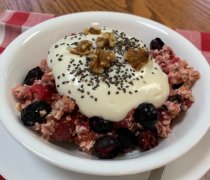
Fresher than Fresh Berry Muesli This recipe has been adjusted to fit into a pint jar for a smaller, more portable serving. So quick and easy to prep, and portable to throw in your bag to take for lunch or eat on a road trip.
In a wide mouth pint jar, layer the following: 1/2 cup Quick Oats 1/4 cup Thrive Life dehydrated Applesauce 1/4 cup Thrive Life freeze dried Blueberries 1/4 cup Thrive Life freeze dried Raspberries 1/4 cup Thrive Life Strawberry Slices Jar will not be completely full, which is what you want to be able to stir the apple juice in later. Secure lid, label and store in cool, dark place. to prepare: Add 1+ 1/2 cup apple juice, and stir in to completely moisten everything. Let it sit aside for up to five minutes to assure everything is completely absorbed. Enjoy! – link to full recipe –
Smoothie in a Jar now smoothies can be totally portable! For a long time (before RUVI became available) , I would blend small amounts of freeze dried fruits and vegetables in the blender and make a “smoothie-in-a-jar”. Convenient and nutritious to take when I was on the run and didn’t have time for a meal. Those are the times you’re tempted to pick up fast food right? But that’s exactly what I don’t want to do. Did you know? 1 Tablespoon of powdered vegetable = 1 serving. ? I just add a little cold water, shake up the jar and drink it. 4 servings of fruits and vegetables with all the nutritional goodness they have to offer. What a gift. You can use any combination you want but my favourite was the following. 1 Tablespoon pineapple powder (made from Thrive Life FD pineapple) 1 Tablespoon peach powder (made from Thrive Life FD peaches) 1 Tablespoon spinach powder (made from Thrive Life FD spinach) 1 Tablespoon kale powder (made from Thrive Life FD kale) layer it or shake it up to mix. This is POWER in a Jar. The natural enzymes of pineapple, the vitamin C of the peaches (and pineapple). The vitamin A, minerals and antioxidants of spinach and kale.
* Did you know?Thrive Life peaches have 21 times MORE Vitamin C than so called ‘fresh’ peaches from the grocery store in the middle of summer. Not even kidding. You read right – 21X more. Wanna know why? Because unlike the peaches we buy in the grocery store, which are picked green, Thrive Life fruits are picked when they are completely RIPE and at the height of nature’s perfection, being nutritionally complete. Everyone knows that produce begins to deteriorate within the first hour after harvest, so eating it ‘fresh’ is ideal. Thrive Life ensures that not only are those peaches picked ripe, but they are picked, peeled, sliced and flash frozen within 6 hours of harvest. That is why they retain 95% (or more) of their original natural goodness. * Did you know? Spinach loses 100% of its vitamin C within 4 days of harvest! Yup, sad but true. When you buy so called ‘fresh’ spinach from the grocery store, there is ‘0’ (ZERO) vitamin C left in it. Thrive Life Spinach is picked, washed, chopped and flash frozen within 6 hours of harvest, retaining pretty much ALL its vitamin C plus a whole lotta other goodness. Up to 95%!
* hint: the natural sweetness of the fruits will eventually cause the fruit powder to compress. The vegetables will not, they’ll stay loose. So mixing up everything might not be as pretty, but it is more likely to stay loose. Your choice. You be you.
so what about desserts? Can you put those into a jar too? Absolutely!
Lemon Pound Cake from your pantry this cake is good for so many reasons, and for so many things: from a simple elegant lemon pound cake, to a gorgeous berry lemon trifle, and everything in between. And its the perfect choice for a MIJ (except its not a ‘meal’). Just add water.
measure the following ingredients into a clean dry quart jar 1+1/2 cups flour 2 t baking powder 1/2 cup Thrive Life Butter powder 3/4 cup white sugar 1 T Thrive Life classic lemonade – or up to 2 T for those exceptional lemon fans 1/4 cup Thrive Life scrambled egg mix 1/2 t salt 3 T Thrive Life Instant milk Secure lid, label and store in cool, dark place.
Blueberry Lemon Cake (made w the crumbled blueberries left in the bottom of a can of Freeze Dried Blueberries)
to prepare: preheat oven to 350 F. Dump contents into a mixing bowl and with wire whisk, gently mix all ingredients till thoroughly combined. Form a well in the center and pour in 1+1/2 cup water. Stir just until everything is moistened. Pour into greased 9×9 pan and placed in center of oven. Bake about 40 minute, until center is done. Test by gently tapping center, then by inserting clean toothpick. When it comes out clean, remove from oven and set aside to cool. Cut and serve. Enjoy.
* option: drizzle with lemon glaze while still warm. Mix 1 T classic lemonade powder with 3 T water and slowly cream in sifted icing sugar to desired consistency. Drizzle over top. Or use 3 T of fresh lemon juice. * option: add 2 T poppy seeds into dry ingredients * option: add 1/2 cup freeze dried blueberries and a little extra water
Do you make Meals in a Jar already? If so, I’d love to hear about your favourite recipes. It’s always good to share. If you haven’t yet, I hope you’ll give it a try. If you don’t have enough freeze dried foods to get started, here’s what THRIVE LIFE has available. They are the biggest freeze drying company in North America, and their quality is second to NONE.
If you’d like suggestions of best ways to purchase, or if you have any questions on particular products, ask away – I use them ALL, and I can suggest best ones for MIJ.
Oats are a staple food in my house for many reasons, and in all the variations. Although I usually prefer the nice thick rolled oats, and even the oat groats, quick oats have a firm place on my list of favourites too. Quick oats are where wholesome goodness and convenience meet, and because of that they’ve earned their spot in my pantry. Adding a little quick oats to baby food helps provide well balanced protein, good representation of vitamin B, and a sustainability that will help baby feel satisfied longer. Keep some handy to add a tablespoon to pureed fruit, soups and yogurt.
I grew up on oatmeal porridge, and oatmeal raisin cookies. Moms for generations instinctively knew that oats were ‘good for you’, and since they’re relatively inexpensive, they were the perfect choice. Good and affordable. Oats had the reputation of “sticking-to-your-ribs”, so were a popular choice for breakfast. But what does that even mean? They are actually, a great source of dietary fiber, (both soluable and insoluable). The primary type of soluble fiber in oats is beta-glucan, which is slow to digest (hence they stick-to-your-ribs), and YES, this is a good thing, as it increases satiety, and suppresses appetite. In short, it is satisfyingly filling, and keeps you comfortable for longer.
But did you know that oats are even better for you than your mom and gramma understood? In fact, oats are among the healthiest grains on earth! They are a gluten-free whole grain and a great source of important nutrients. Although delicious and nutritious, most people are unfamiliar with the whole grain – groats: the hulled, whole seeds of the plants. We’re more familiar with rolled oats.
Oats are a great source of important vitamins, minerals, fiber and antioxidants, like potassium, calcium, magnesium and several B vitamins and Vitamin E, as well as trace minerals: manganese, copper, iron, phosphorus, selenium and zinc, AND – big bonus . . . Oats are a good source of protein. One of the richest sources of protein in the grain family: 11-17% dry weight. Truly, the humble OAT is a grain that deserves a place in your kitchen and in your family’s daily diet.
Groats: All oats start off this way: the whole, unbroken grains. Before being processed into any other form, groats are usually roasted at a very low temperature. This not only gives the oats their nice toasty flavor, but the heat also inactivates the enzyme that causes oats to go rancid, making them more shelf-stable. If you have never cooked up groats, then you owe it to yourself to give them a try. Because they are the original source of oats, they should always be the first “go-to”, but admittedly, they take a little longer to prepare (which is still worth it bytheway), so in our fast passed society, they often get sidelined. Cooked groats have a beautiful chewy texture that retains much of its original shape, and more of a nutty, earthy flavour than regular rolled oats. – see recipe below –
Steel Cut Oats: are simply groats that have been cut to make them quicker to cook. Sometimes referred to as Irish oats, these oats look similar to rice that’s been cut into pieces. Chopping them makes them easier to cook and exposes the starches inside to the water. These starches dissolve during the cooking process, creating a thickened, creamy porridge. It takes a little less time to cook than the whole groats, but has that same beautiful chewy texture. True Scottish oats are ground on stone mills from whole oat groats. They are not rolled, nor cut; they are ground. The texture of Scottish oatmeal is fairly fine.
Steel cut groats are more than porridge: add to stuffing, and even made a savory congee. – see recipes below –
Rolled Oats (or Old Fashioned Oats) These are the oats I grew up with, but in those days we mostly used them for porridge and cookies. My mom also used them in meatloaf.
I’ve since, taken oatmeal to a whole new level and I think I make the best in the world. (only slightly kidding). See recipe (such as it can be) below.
When I was a young mom, my mother in law introduced me to OATMEAL SOUP. The name is not very inviting, but it became a family favourite in our house. I’ve often made it for others, but I never call it by that name because of the images it conjurs up lol. – see recipe below –
My first experiments with Muesli were with the old fashioned rolled oats, which I started the night before. It was pretty much rolled oats and chopped dates in milk, soaked over night. I liked it, but my daughter disliked dates. Immensely. The concept of an uncooked ‘oatmeal’ intrigued me though, so I determined to keep it up, with some necessary adjustments. See below for more on Muesli.
Quick Oats Oat groats that are steamed for a longer period of time and rolled into thinner pieces so that they can absorb water easily and cook very quickly, or not even at all. NOT to be confused with the boxed “instant oatmeal”, available in stores now which contains quick oats plus a lotta sugar and artificial flavours. Instant oatmeal does not deserve a spot in my pantry.
For porridge, I never use quick oats, but they do come in handy for other things. Their convenience justifies their position in my pantry, and I though I rarely used them when my kids were younger, I wouldn’t want to be without them now. They are the base for my Muesli recipe (below), and I often add quick oats and blueberries to yogurt.
the flexibility of oats Truly, I do not know why oats are not more of a common food in most households. They are SO much bigger than the porridge of our childhoods.
Oatmeal: Yes, that generational breakfast favourite – cooked rolled oats. I have fond childhood memories of oatmeal on winter mornings before school, and I hope my kids have those same memories. I’m doing my best to make sure my grandkids do. – see recipes below –
Oat Flour: Your can buy or grind your own oat flour. Throw a little into cookies or bread for a boost of nutrients, and added chewiness.
Oat Bran: Oat bran comes from the outer part of the groat. If you grind your own flour, you can get oat bran by sifting coarsely ground groats. Or you can buy it. When oatmeal is processed, the bran (outer layer), is removed. Oat bran is a good source of protein, B vitamins, iron and soluble fiber. It is used to make porridge, and as an ingredient in a variety of hot and cold cereals, as well as in breads, cookies and muffins. Fiber adds bulk (not calories) to foods, so it helps “fill you up without filling you out.” Oat bran is particularly rich in a type of fiber called soluble fiber, which turns into a gel-like substance in your stomach. This helps you take in fewer calories overall.
Oat Risotto: Simply replace oat groats in your favourite risotto recipe. Easy peasy.
Oat Congee: Congee is a thick Asian comfort food, traditionally made with rice in a meat broth. Simply substitute in oats. Because it uses more water and is cooked longer, congee began as a way to stretch the rice in hard times. Usually a thick stew, or even a porridge (or gruel) type of dish. From its humble beginning, who knew it would turn into a favourite food of so many, and even find its way onto restaurant menus? I guess that’s the way with most comfort foods, they start out as necessities: poor people’s food. Adding rice to a brothy soup and simmering it till the rice actually thickens the soup, essentially IS ‘congee‘. Well you can do the same thing with barley, so why not oats? Remember, you’re the boss. You can add it to any soup recipe that calls for rice or barley. And you can flavour it any way you like. – see below for sample recipe –
Muesli
Let’s talk about Muesli, because it really does deserve more attention than it gets. Developed in the early 1900’s by pioneer nutritionist, Swiss physician Maximilan Bircher-Benner, he used it for convalescing patients in his private hospital. It was not originally intended as a breakfast, but more of an appetizer. Bircher-Benner’s focus was a diet rich in fresh fruit and vegetables which he used as an essential part of his nutritional therapy. Truly, he was ahead of his time. Who knew that over a hundred years later we’d finally understand how important a focus on fruits and vegetables is to our health. And Muesli has stood the test of time, as it is ever growing in popularity.
The original 1900 Bircher-Benner recipe consisted of : apples and nuts in a base of rolled oats, with lemon juice. The oats were pre-soaked water for up to 12 hours, then mixed with grated apples (the most readily available fresh fruit in Switzerland at the time). They were served with milk or cream, sweetened with honey or a small amount of sweetened condensed milk. The lemon juice helped keep the apples from browning. The idea was to serve a small amount of muesli immediately before every meal, as an appetizer of sorts. Modern adaptations of Bircher-Benner’s recipe includes more fresh fruit.
Years ago, when my older kids were little, I came across what was referred to as a traditional Swiss Muesli recipe: large flaked oats, dates and other dried fruit and topped with yogurt and toasted almonds. It was delicious and nutritious. Soon enough I realized the potential for flexibility, and muesli progressed to include whatever fruit was fresh in the summer, or whatever home canned fruit I had on hand in the winter. Some things were constant: usually shredded apples and raisins. Some things varied: sometimes apple juice, sometimes milk. Muesli is like that. Flexible and wonderful.
Though my recipe has evolved over the years, I’ve generally depended on apples as the fruit base, mostly because they were so readily available throughout the year. Other fruits I added depended on the season. As time went on, and freeze dried fruit became more available, my dependence on seasonally available fruit lessened. And less nutritious canned fruit became a thing of the past. The base is still oats, but it fluctuates between rolled oats or quick oats. Rolled oats if I start the night before, quick oats if I decide at the last minute (which is more often these days). Its a breakfast for us, or a lunch, or even a late day snack. – see recipe below –
RECIPES
Oat Groat Porridge ready to go!
Oat Groat Porridge(for two servings) remember, you’re the boss. If you prefer all water, or all milk, or all another type of milk – you do you. This is just how I do me.
1/2 cup oat groats 1 cup water pinch of salt (not more than 1/8 t) 1 cup milk I T maple syrup or brown sugar or honey
Because groats are a whole grain, they take longer to cook, so I find it helpful to give them a little head-start. 1/2 cup whole groats in 1 cup water, bring to a boil, stir, then turn heat off. Let sit overnight (8 hrs-ish). In the morning, t will already be tender and chewy, turn the heat back on and stir, bringing the groats to a boil again. Add a cup of milk and lower the heat a little to bring it back to a slow boil, stirring frequently to prevent sticking. Reduce to low, cover and let simmer gently for about 15-20 minutes, stirring once in a while to prevent sticking. The texture will be gently soft, but still chewy. If desired, sweeten with your choice of sweetener. I like maple syrup. Serve and Enjoy.
Steel Cut Oat Porridge A basic ratio for making steel-cut oat porridge is 1 cup of oats to 3 to 4 cups of water. Less water keeps the oats more intact and chewy. More water makes a silkier porridge. Try it a few times to nail down the way you prefer it. I like to start with 3 cups water, and then add the last cup in milk toward the end. Or use all milk. You’re the boss. Add a pinch of salt of course.
Cooking steel-cut oats is easy. Simply boil water, add oats, reduce heat, and simmer. But give it ‘time’, like 20 to 30 minutes to become tender. Start testing your porridge around 20 minutes, and continue slow cooking, testing every few minutes till its perfect. If the oats are tender at 20 minutes, it will still thicken up a little to leave it on heat for a little longer. Try it a few times to find your favourite way. To serve, pour a little more milk over top, and add a spoonful of brown sugar. Try using maple syrup to sweeten instead of sugar. I like putting raisins, or dried or freeze dried apricots on the top.
Because groat porridge takes so long to prepare, you might want to cook a little more, and refrigerate some for tomorrow. It will get dry in the fridge, but don’t despair, just add a little more milk and warm it up. Problem solved.
If you’re the type of person that must see an actual recipe, then see below, but remember, you can edit the details to your heart’s content.
1 cup steel cut oats 2 cups of water and 2 cups milk a pinch of salt (about 1/8 teaspoon) Bring 2 cups of water to a boil. Add the salt and groats, stir well to prevent sticking on the bottom. Return water to a boil, stirring. Reduce heat to low, add 1 cup milk, stir again and cover. Allow to gently simmer for about 10 minutes, checking every once in a while and stirring to prevent sticking. Cover again, and continue to simmer for another 10 minutes. Add that last cup of milk if you want and simmer another 5-10 or so minutes. That’s where personal choice comes in. When it is the way you want it, spoon into bowls and serve with a little more milk over top and a little brown sugar. Serves three or four depending on how much milk you added at the end.
Cindy’s Oatmeal: I cook mine as little as possible. Bring 2 cups water (with a dash of salt added) to a boil. Add 1+1/2 cups rolled oats. Return to a boil, stirring to prevent clumping. Add 1 cup milk and a little sweetener (usually brown sugar). Gently simmer a few minutes and serve. I occasionally add raisins to the boiling water (just before the oats), as a special treat. Or maybe some freeze dried fruit at the end: blueberries, raspberries, apricots. To me, oatmeal is great with several different fruits like apples, peaches, pears and cranberries. I never use Quick oats for cooked porridge (too mucky, I like the integrity of whole rolled oats). I do however, use them for Muesli, or to add to yogurt bowls.
Overnight Oats: a quick, easy no-cook option. For one person use a pint sized jar: put ½ cup rolled oats + 1 cup milk of your choice + ½ cup fruit of your choice (banana, apple, peaches, etc). Add 2-3 T Greek yogurt + 1 T brown sugar or maple syrup. Put lid on, and shake vigorously till all is incorporated. Refrigerate overnight. The oats will soften and the mixture will thicken. Optional: sprinkle toasted nuts or seeds over top in the morning. Ready to “Grab n Go”.
fresher than fresh muesli made with freeze dried fruit
FRESHER THAN FRESH MUESLI serves 2 or 3, uses mostly freeze dried fruit and takes five minutes to prepare. It doesn’t get any easier than this. 1 c. Quick Oats 1/2 c. dehydrated Applesauce 1/2 c. freeze dried Blueberries 1/2 c. freeze dried Raspberries 1/2 c. freeze dried Strawberry Slices 2 c. Apple Juice (approx)
Lightly stir to moisten completely, and let sit for 5 or so minutes to absorb juice. Add more juice as desired to keep it the texture you want. Serve. That’s it. It really IS that simple, and that quick. And that delicious. NO fat, NO sugar, NO dairy, NO wheat, NO additives of any kind. Super Nutritious and Delicious. Remember, you’re the boss. If you don’t have or want berries, then use what you have or prefer. Option 1: use any kind of fruit, substitute your faves or what you have on hand Option 2: use any kind of juice or milk, substitute your fave or what you have on hand. I prefer apple juice because is mild tasting allowing the other tastes to come through. Option 3: top it off with added nutrition in your bowl: a scoop of plain yogurt, a sprinkling of toasted nuts, or seeds: sesame / chia / hemp seeds. Be creative. Muesli is flexible.
Muesli takes on a whole new world of possibilities with freeze dried fruits. Always ‘fresh’ and always at their nutritional peak, you can have any kind you want because you have all-the-fruit all-the-time in your home-store. No matter what time of year, THRIVE freeze dried fruit is “fresher-than-fresh”.
basic recipe for a Greek Lemon Chicken Soup. Instead of using rice, use groats
Oat Congee first of all, don’t get tied up in using a specific recipe like this one. Congee is simply adding the rice (or groats) to more liquid than usual and slow cooking it till they come to a very soft stage where they thicken the broth. 1 cup steel cut oats 4-6 cups vegetable or meat broth 1/4 teaspoon salt 1/4 cup minced onion (I use chopped freeze dried onion) 1/4 cup finely chopped carrots (I use Thrive Life dehydrated carrots that are diced) 1/4 cup chopped mushrooms (I use freeze dried mushroom pieces) small amount of diced meat (leftover meat of your choice, or use diced freeze dried beef) 1 T freshly grated ginger, or 1 teaspoon fresh ground ginger 1 teaspoon soy sauce 1 teaspoon rice vinegar Bring the broth to a boil and add everything in. Reduce to a simmer and gently cook for about 30 minutes, stirring occasionally to prevent sticking. If it starts to get a little ‘thick’ add more liquid.
CINDY’S OAT SOUP (serves 6) 1 cup rolled oats 1/3 cup butter + 2 Tablespoons 1 onion chopped 3 cloves garlic, minced 8 cups chicken broth (or bouillon) 1 or 2 bay leaves 1 quart home canned tomatoes, or equivalent in canned or ripe tomatoes (3-4 peeled and chopped) 1T dried oregano crumbled salt and pepper to taste later Melt butter in large heavy skillet, over medium low heat. Add oatmeal and brown slowly, stirring constantly to prevent burning. It will burn suddenly, so be watchful. When nice and toasted, and smelling good, remove from heat and set aside in a bowl. In soup pot, use remaining butter to saute onions and garlic. Add stock, tomatoes, bay leaves and oregano. Bring to a boil and add toasted oats. Reduce heat. Simmer covered for about 45 minutes, stirring once in a while to prevent clumping or scorching. Taste and adjust seasoning if needed. Turn heat off and allow to sit for 15 minutes to thicken before serving. This is a soup that is just as good on the second day, and will have thickened even more. And yes, this is a type of ‘congee’.
PATTI SHENFIELD’S OATMEAL RAISIN COOKIES (our family’s favourite cookie) 1 1/2 cup butter or margarine 1 1/2 cup white sugar 1 1/2 cup brown sugar 3 eggs 2 t vanilla 1/4 cup milk 3 cup flour 1 1/2 t baking soda 1 T baking powder 1/2 t salt 3 cups rolled oats 3/4 cup coconut (optional) 3 cups raisins (or chocolate chips or both) In large bowl cream butter and sugars. Add eggs one at a time, vanilla and milk – beat until fluffy. Combine dry ingredients separately then add to creamed mixture one cup at a time. Mix until well blended. Stir in oats and raisins and coconut if you’re using. Preheat oven to 350 F. Drop by teaspoon onto ungreased baking sheet. Bake 10-12 minutes. Yield 7 dozen cookies.
* Are oats gluten free? Yes, oats are gluten free, but many commercial brands are processed in facilities that also produce gluten grains like wheat, rye, and barley. Since cross-contamination is common, many GF people feel the need to avoid oats altogether. Big fat shame, and big loss to the individual. If you’re a gluten free person, you don’t have to miss out on oats. Simply look for the “gluten free” label signifying that they’ve been protected from contamination.
Super foods do not have to be exotic, and blueberries are the perfect example. These sweet, nutritious and wildly popular berries are NATIVE TO NORTH AMERICA. Yay! They are low in calories and incredibly nutritious, and so convenient to eat by the handful. They are primarily a northern fruit, and as a northerner, I am pretty happy to lay claim on these hardy, dark blue berries.
The list of the health benefits of Blueberries is almost too good to be true. And far be it for anyone to exaggerate those kinds of things right? But a little research should help disperse the nonsense from the credible. You’d be surprised at how many credible and documented benefits there really are. We don’t need to exaggerate. For example, its been well documented for decades that blueberries are good for your eyes, and health periodicals have sang their praises my whole adult life. Nevertheless, I was a little surprised when my eye doctor advised me to eat 1/2 cup of blueberries a day as part of a preventative regime for two genetic eye diseases I am in line to inherit: macular degeneration and glaucoma. I believed it before, but it felt good to have her further testimony. And yes, I try to eat a few handfuls every single day.
But wait, there’s more! Blueberries help lower your cholesterol, reducing your risk of heart disease. Packed with antioxidants and phytoflavinoids, blueberries are high in potassium and vitamin C. They are also anti-inflammatory. Since inflammation is a key factor in all chronic diseases, blueberries can and should be your personal BFF (best friend forever).
Blueberries have been the subject of medical studies related to vision for over a century, and blueberry extract, (high in compounds called anthocyanosides), is found to slow down visual loss. (hence my doctor’s recommendation) The anti-oxidant properties prevent or delay all age related ocular problems like macular degeneration, cataract, myopia and hypermetropia, dryness and infections, particularly those pertaining to the retina. Imagine a superFOOD — not a drug — powerful enough to do that! Truly, “Let food be thy medicine, and let medicine be thy food.”
inside colour of a ripe blueberry
If you are among the few not familiar with the taste of blueberries, this is my best description: small, but juicy. Mild, slightly sweet with a tiny bit of acid. Unripe, they’ll be a little sour. And they aren’t actually a true blue, but rather more of a deep blue/purple, which is the colour of the antioxidant “anthocyanin” found especially plentiful in them. The inside however, is a light greenish yellow. A good rule of thumb is, the darker the berry skin, the richer the antioxidants.
So that brings us to their availability. Fresh, I can find them in local grocery stores in 10 pound boxes for about six weeks in the summer; and in the off season, they are often available trucked in, in smaller clam-shell containers. Kinda pricey in the winter, and if you know me at all, you know that I am a big proponent of seasonal eating (mostly for nutrition’s sake). Just because we can buy it, doesn’t mean we should. Personally I don’t buy ‘fresh’ blueberries in the winter. The use of the word ‘fresh’ in the off season, is misleading at best. Frozen blueberries are an excellent alternative, and are even more nutritious than produce section options in the off season. Why? Because produce destined for the freezer, are frozen QUICKLY, sealing in valuable nutrition. But as you know, frozen blueberries are not so convenient to consume. Who wants to eat them frozen? And worse, who wants to eat them thawed and soggy? I take it one step further, and buy only FREEZE DRIED BLUEBERRIES for those other ten months of the year.
How is that possible? Well, for one thing, the word “fresh” is a relative term. Fruits and vegetables begin to deteriorate in the hour they are harvested, so getting them from field-to-table as soon as possible is very important. By the time our “fresh” fruits and vegetables are picked, packed, shipped, distributed and shelved, several days have elapsed. Nobody’s fault. Its just part of the process that allows us the great privilege of food variety we enjoy. But, the reality is that it is no longer at its best by the time we see it. Then we buy it, and put it in our fridge for several more days. . . . . . . I think we get the picture.
Introducing FREEZE DRIED BLUEBERRIES
As it implies, freeze-drying is a two step process. It is flash frozen, then transferred to a facility where it can have all the remaining moisture removed through a vacuum-like process. While the two step process is pretty standard, producing a higher quality product, there are additional steps that can be taken to further ensure the highest quality result.
– It is critical that the fruits or vegetables be the highest quality to start out with. – It is critical that they be flash frozen quickly after picking. – It is also critical that those fruits and vegetables be picked ripe, with all the nutrients that nature designed present and fully developed.
The result? Beautiful crunchy blueberries! That can be eaten out of hand, over top cereal or yogurt, in smoothies, baked in pies or muffins, . . . . . . any way a fresh blueberry can be eaten. Any. Day. Of. The. Year! And get this: they have a shelf life of over 25 years! How is that even possible? Zero moisture, packed into a sealed zero oxygen container = no way to decompose. So not only is the nutritional value an unprecedented 95+% of the original freshly picked value, it has a completely stable shelf life. You can enjoy that kind of quality today, tomorrow, next year, in ten years, and so on. Once you open the can, simply keep a tight seal on it, and you can expect it to last a good year in most climates. (not that there will be any left in a year, but that’s not the point lol)
There is a North American company that stands out from the rest when it comes to the highest quality of freeze dried food. THRIVE LIFE operates by a self imposed list of requirements they call “The Nutrilock Promise“. By adhering to these requirements, they have raised the industry standard to new heights that no other company has been able to come close to. There are over 40 steps in the process, and compromises are never made.
Other Health Benefits of Blueberries:
– A bowl of blueberries can help in boosting immunity and can reduce the risk of diabetes, obesity and heart disease. – Consuming as little as 1/2 cup of blueberries daily helps strengthen your metabolism and prevent any kind of metabolic syndrome and deficiency. – It has been observed that daily intake of blueberries can help reduce hypertension, inflammation, high cholesterol, glucose intolerance and insulin resistance. – Blueberries are also known for improving cognitive skills such as attention, memory, and information organization.
Where do they grow?
Blueberries typically grow in humid, northern climates that have cold winters and mild summers. They prefer slightly acidic soil. This makes them the perfect northern berry, and it is not surprising that they are native to North America. They are also successfully grown in the more temperate areas of North American, including coastal regions, and have been introduced to several European countries as early as 1940.
Canada is the world’s largest producer and exporter of both wild and cultivated Blueberries. The majority of Canadian blueberry production is in British Columbia, where water and soil seem to be perfectly suited. Most of that is exported. New Brunswick is Canada’s second largest blueberry producing province, accounting for 30% of the country’s total production.
in varying stages of ripeness
They grow on dwarf shrubs of the heath family, with small, whitish drooping flowers that turn into the beautiful dark blue berries we know and love so much. I grew up picking wild blueberries in the summer, and though those days are over for most of us, market-garden-blueberries are very available. Having said that, if you live in rural areas, wild blueberries can still be found in abandoned fields, along roadsides, in forests and on mountains. They spread through seeds and the development of rhizomes, (underground stems). They are becoming more available in garden centres for those adventurous gardeners who want to have them closer to home.
Ways to Use Blueberries
#1 is FRESH out-of-hand of course. When that is not possible, freeze dried out-of-hand is a very close second. A new favourite way for me to enjoy them in the winter time, was introduced to me by my friend Reese Wolsey. Blueberry tea. Simply pour boiling water over a handful of blueberries in your mug. Let steep for a few minutes and drink. SO good. And when the cup is drained, eat the blueberries. Blueberry preserves for pancake and waffle topping. I just add a little water and simmer gently, mashing with a potato masher. Add a little sugar if desired, but not necessary. If you want to make more of a syrup, add a little more water and thicken with cornstarch. Also great for ice cream topping. Fresh over top of cereal. Blueberries in your oatmeal. Blueberry cheesecake. Blueberry muffins. Blueberry pancakes or waffles. Blueberry pie. Blueberry cobbler. Blueberries in your coffee cake, and added to lots of other baking too. Blueberry yogurt bowl. Blueberry ice-cream. Blueberry jam. Blueberries in your green salad with a little crumbled feta. Oh my goodness, there is no end to the ways you can incorporate them.
Blueberries have been my husband’s favourite fruit for as long as I’ve been married to him, but up till recently we could only enjoy them for a relatively short time in the summer. Now that we can enjoy them ‘fresh’ in the summer, AND freeze dried (in most cases, fresher-than-fresh), all the rest of the year – they have become an important (and welcome) part of our household diet. They are the #1 Fave Snack of ALL our grandchildren, and I’m totally okay if some of their best childhood memories involve eating freeze dried blueberries at Gramma’s house. Even if I do have to limit them most of the time. Seriously, they inhale them if left unsupervised.
I’d love to hear your thoughts on blueberries. And different ways your household enjoys them.
Top reasons to eat Sauerkraut
1 – improves digestion as it is an excellent low calorie source of soluble fibre. Introduces healthy bacteria to the gut
2- good source of vitamins and minerals including fragile ones like Vitamin C
3 – low in calories
4 – high in soluble fibre
5 – it tastes great
Sauerkraut – literally translated, means “sour cabbage”, and that is exactly what it is. I’ve heard some refer to it as ‘pickled’ cabbage, but to be clear – it is fermented, not pickled. What’s the difference? Well, I’ll admit they may be similar in taste and features perhaps, but it is in the process by which that sour taste is achieved, that we find the difference. Pickling for example, is a method of preserving foods in acidic liquid like vinegar. One type of fermentation is the process of using naturally occurring good bacteria to produce lactic acid, which in turn breaks down the sugars or starches in a food turning them into acid. This is the fermentation used in common foods such as sauerkraut, kimchi, yogurt and even sour dough bread.
sitting on the counter to ferment
Why do we care? Fermentation produces PRObiotics, which support the body in building and maintaining healthy bacteria and other helpful organisms in the intestinal tract. This beneficial bacteria promotes a healthy gut and good digestion, which ensures we get the best from the foods we consume. PREbiotics are a source of food for your gut’s healthy bacteria. Both are necessary for good health. It starts to get very complicated but the process of making sauerkraut is super easy, and since the benefit of eating fermented foods is good health, we really should try to add more of them to our diet.
Although one most often thinks of sauerkraut with eastern European foods like Ukrainian, Russian or German, the process of fermentation actually originated in Asia with something very similar. It is believed the Mongols brought the preservation process with them to eastern Europe during the conquest of the 13th and 14th centuries. As a cold weather crop, cabbage does well in northern climates, and fermenting it is a brilliant food preservation technique. It was readily adapted by those eastern European countries we associate it with.
When we (in my house), first made sauerkraut many years ago, we followed a process of layering finely shredded cabbage with pickling salt and pushing it down to produce liquid which the salt drew from the fresh cabbage. I have since learned that a little bit of patience mixed with the same ingredients, allows the salt to do its thing with a lot less manpower. And when we first made sauerkraut we did a big batch – like we did everything in those days. When you have a big family, big batches of everything becomes the habit. But as life went on and family dynamics have changed, I’ve fallen in love with small batch preserving when its to my benefit. Since cabbage is in season from late summer through early winter, it is easy to make up a single quart here and there. The key is ‘patience’. The #1 rule with sour dough is “don’t try to rush the sourdough“. And the same principle applies to fermentation of any type. Don’t try to rush it. Don’t forget about it, but don’t rush it.
Health Benefits
Fermentation multiplies nutrition and health benefits far beyond those of fresh cabbage. Cabbage is already a good source of vitamins C and K, but the fermentation which transforms it into sauerkraut increases the bioavailability of nutrients, making it even more nutritious than the original cabbage. Fermentation is a process during which microorganisms on the cabbage digest its natural sugars, converting them into carbon dioxide and organic acids. It starts when yeast and bacteria that are naturally present in the air, the cabbage itself, and even your clean hands, come into contact with the sugars in the cabbage. Sauerkraut fermentation creates conditions that promotes the growth of probiotics (good bacteria). This helps make foods more digestible, increasing your gut’s ability to absorb vitamins and minerals.
Maintaining a healthy gut helps prevent the growth of harmful bacteria, improving our immune system. Its a natural way of putting your body in the best position possible to fight disease.
It is a good source of Vitamin C, calcium and magnesium and an excellent source of dietary fiber, folate, iron, potassium, copper and manganese.
Top reasons to eat Sauerkraut 1 – improves digestion by introducing healthy bacteria important to proper gut function 2- excellent source of vitamins and minerals including fragile ones like Vitamin C 3 – low in calories 4 – high in soluble fibre 5 – it tastes great and is very versatile to incorporate into meals
How to Store Sauerkraut: Although you can preserve it in a hot water canner, the heat damages the vitamin C and naturally occurring enzymes as well as the live lactobacilli. Since it will last months in the fridge – it is my preference to simply refrigerate it and use it throughout the winter.
Store bought vs homemade: Now don’t get me wrong. I appreciate having healthy foods available commercially. And certainly, store bought versions are often the only way many people will get them. But, as with most things, store bought sauerkraut is considered to be less nutritious compared to homemade sauerkraut – mostly due to the necessary processing. Store bought sauerkraut has to be preserved somehow of course, and so must undergo a pasteurization during canning. This eliminates live probiotic content – which is one of its main benefits.
Store bought benefits: availability, shelf stable, still low calorie, still a good source of soluble fibre and non water soluble vitamins and minerals. Tastes good. Homemade benefits: easy to make, will last in fridge for a long time, still low calorie, still a good source of soluble fibre and ALL original vitamins and minerals (including VC). Rich in antioxidants and live enzyme probiotics. Tastes better.
Having said all that, I was in the Maritimes recently – in a grocery store, and saw some ‘fresh’ sauerkraut in the refrigerated part of the produce department. Did my heart good. If you’re gonna buy sauerkraut, look for this HIGHLY better option.
history
Eating sauerkraut played an important role in preventing scurvy in the early days of sea travel. Scurvy – the scourge of the seas in its day, resulted from an absence of vitamin C in the diet. Symptoms begin after a month, and the only prevention and cure for it is Vitamin C. It was the primary cause of deaths between 1500 and 1800 — on sailing ships around the world. It was so common, that a 50% death rate on every voyage from scurvy was assumed and planned for.
Long before it was understood ‘why’, it was discovered that sauerkraut prevented scurvy. Scottish naval surgeon James Lind noticed that scurvy was linked to a diet which was severely limited. He began testing various foods and noted that citrus fruits provided the quickest and most effective cure for the disease. However, citrus fruits were not readily available in Europe, and it was impossible to keep fresh fruit on a sailing ship for months at a time.
Experiments using different types of food on sailing expeditions began in earnest, and famed Captain James Cook drew the lucky straw with sauerkraut in 1768. He was outfitted with almost 8000 pounds of the fermented cabbage, each man being rationed two pounds a week, and at the end of his three years’ journey, returned without a single death attributed to scurvy. An incredulous first! It literally changed the world! The number of lives that were saved with this discovery is unimaginable. A century later, during the American Civil War, physician John Jay Terrell began using sauerkraut to treat the same disease. In times when Vitamin C – the “fresh fruit vitamin”, is not so easy to come by, sauerkraut is a practical and healthful solution.
Let me just stop here for a moment and bask in the wonder of all this. It is amazing to me that ancient people could figure out how to harness the fermentation process and make it work for them. Without the knowledge of vitamins, bacteria or gut health, they came across a food that quite literally not only preserved their lives in winter times of no fresh fruits or vegetables, but preserved their health, enabling them to better digest foods, increasing their body’s ability to absorb important nutrients. And this, in a common farm house of illiterate people. If you are a believing person as I am, this is nothing short of a miracle – Evidence that a loving Father in Heaven cares intently about the affairs of his children.
making it
Making sauerkraut is embarrassingly easy, and I’m convinced when you discover just HOW easy it is, you’ll be making it frequently. It requires no special equipment. Yes, there are things traditionally used, like a crock and a wooden pounder, but you can also make it in a bowl with a potato masher, and stuff it into a glass jar with a lid. And yes, you can use a food processor, but I do not. I prefer to use a large knife and slice it thinly myself. And yes, if you make a lot, you might want to can it, but if you make less, you can still store it for months in your fridge, so I prefer not to can mine – but to take advantage of the full nutritional benefit of raw. Its another example of how eating seasonally is best.
Equipment: Okay I lied, you do need some things. Get a large, sharp knife for slicing the cabbage. A cutting board on which to cut it. A large enough bowl to hold the shredded cabbage while you toss it. A container to store it in: wide mouth glass jar or a crock of some sort . . . . I prefer glass or pottery. EVERYTHING SHOULD BE VERY CLEAN OF COURSE. I do not sterilize everything I use, but it is very clean, and cleaned continually as needed, throughout the process.
1. necessary: cutting board, sharp knife, container to store – jar, corning are with lid, crock … 2. necessary: large bowl or tub to mix the cabbage with salt 3. optional but handy: some kind of tool to push cabbage down with, scraper to help transfer it from board to bowl, canning funnel to help put cabbage into jar
Ingredients: cabbage and salt. That’s it! Really. That’s it. For a large head of cabbage – (approximately 5 pounds), you’ll use 3 heaping tablespoons of salt. NOT table salt which contains iodine, but pickling salt, or sea salt. I prefer coarse salt.
The SALT has a very important job – it draws the moisture out of the cabbage, helping to form the BRINE, it causes the cabbage to release fermentable sugars. Salt is also a natural preservative, inhibiting the growth of undesirable yeasts, molds, and bacteria. Through the miracle of nature, the bacteria needed for safe fermentation tolerates high concentrations of salt. Submerged in this brine for a week or more, the cabbage slowly ferments into the crunchy, delightfully sour – sauerkraut.
Some people add dill seed or caraway seed or even use purple cabbage. I think these are great ideas, and one day I might try a single jar of purple cabbage or even dill seed. But I hate caraway seed so that’s never gonna happen.
What causes this transformation called lacto-fermentation? There is beneficial bacteria naturally present on the surface of all fruits and vegetables. Lactobacillus is one of those bacteria, which bytheway, is the same bacteria found in yogurt. When submerged in a brine, the bacteria begins to convert sugars in the cabbage into lactic acid; this is a natural preservative that inhibits the growth of harmful bacteria.
Since this process is anaerobic – which means ‘without out oxygen‘, the cabbage must remain completely submerged in its liquid during fermentation. This is accomplished by packing it down firmly, and then placing some kind of weight on top. I have used a heavy rock (cleaned and in a plastic bag), plates, smaller glass jars . . . be creative. Find something that you can sufficiently clean, to set on top of your sauerkraut to keep it submerged. The cabbage near the surface wants to float, so I find it useful to place a large outer leaf of the cabbage over the surface to hold it down. Of course you want to ensure the jar or crock is covered at all times with a clean cloth. This allows airflow, and protects the surface.
the glass jars allow you to see the three layers beneath the weight: 1. tightly packed cabbage mixture on bottom 2. folded cabbage leaf to cover cabbage and prevent any from floating to surface 3. natural brine which is produced from pushing cabbage salt mixture 4. weight of some kind to keep everything safely below the surface 5. cover to protect from evaporation and contaminants, but not completely airtight
How long does it take?
It could take days or weeks – depends on you, your personal preference, and the temperature of the room you’re storing it in. The cooler the room, the longer the time. I suggest tasting it anytime after the first week. I expect my sauerkraut to be ready in about a month, but testing it weekly will let you know. When you like it, simply put it into the fridge. It will continue to ferment in the fridge too, but at a much slower rate.
In a glass jar, you may see bubbles, foam, or white scum on the surface of the sauerkraut. You won’t see them in a crock, but they’ll be there. All signs of normal, healthy fermentation. The white scum on top can be skimmed off as you see it, in both glass jar or crock. It’s possible that the brine might bubble over during the fermentation process, so best not to pack your containers too full, and have them sitting on a cloth to absorb excess moisture, or a plate to catch it. You should be checking the progress every couple of days anyway. This helps you trouble shoot. If you see white scum, remove it. Taste it frequently with a clean fork to test for doneness. NEVER RETURN THE FORK TO THE SAUERKRAUT ONCE YOU’VE PUT IT IN YOUR MOUTH. GET A CLEAN ONE. Ensure the cabbage continues to be covered by the brine.
image on left: 5 gallon crock free from cracks, filled 2/3 – 3/4 with tightly packed cabbage (approx 3 1/2 cabbages). Covered loosely with plastic wrap to reduce evaporation and clean cloth. image on the right: large stone in plastic bag weighing down plate. Beneath plate is cabbage leaves protecting the sauerkraut and preventing any from escaping to the surface.
Troubleshooting
Mould: We have in the past found mold growing on the surface of the sauerkraut. Don’t panic. This is not rare, as mold typically forms when the cabbage isn’t fully submerged. Simply remove the offending pieces and re-ensure the rest is submerged. The sauerkraut is still fine being preserved by the lactic acid. Be smart though. Yes, a little mold that you can easily remove is not bad news, but a lotta mold that is affecting an inch or more into your sauerkraut IS bad news. That would only happen if you’ve run out of brine. Perhaps your container was too full and the bubble-over, took away too much of the liquid to keep the cabbage completely covered. Or perhaps it evaporated. Be proactive, if you’re running out of liquid you need to address it sooner than later. Better to remove some cabbage to allow the remaining cabbage be fully submerged. You can always eat the mild sauerkraut you’ve removed. Better that, than to risk harm to the batch with reduced liquid.
Adding more liquid: If you must add more liquid DO NOT add vinegar. I know its tempting because it seems to make sense, but don’t. The sour flavour of fermented sauerkraut comes from lactic acid produced by the bacteria, not from vinegar. NOT the same thing. Vinegar will kill the beneficial bacteria needed for fermentation. On the other hand, a salt water brine will maintain it.
The cabbage will produce its own liquid when salt is massaged into it. As it releases liquid it becomes more limp and able to be compacted down into the jar – squeezing more liquid out of it. You want the cabbage submerged, ideally by at least 2 inches of brine (5 cm). In time, some liquid may evaporate. You cannot allow the cabbage to become dry on top or it will begin to mould. I don’t recommend using plain tap water, but if that’s all you’ve got, boil it ten minutes first, then cool it. I prefer to use distilled water. Whichever you use, dissolve 1 teaspoon of salt in 1 cup of water to keep from diluting your salty brine. Add enough to re-submerge the cabbage, but don’t use more water than necessary.
Recipe:
1) Remove the ugly outer leaves and discard into the compost. Remove another leaf or two and set aside to use later. I begin by cutting the cabbage in half, then in half again. Remove the core from each quarter, and slice. Slice thinly as you would for coleslaw. Scoop all the sliced cabbage into a large bowl or kitchen tub.
1. choose a beautiful cabbage 2. chop it up 3. sprinkle pickling salt over top 4. toss to coat completely, then set aside
2) Salt: 3 Tablespoons for a large cabbage. Adjust as needed for smaller cabbage. Its not an exact science so don’t stress about it. Sprinkle salt over top and gently toss to fully incorporate. I use my hands, its just easier. Massage the cabbage for about five minutes.
It seems like it won’t be enough salt, but trust me, it is. As you toss the cabbage, you’ll see within the first minute that moisture is already beginning to be drawn out of the cabbage. Gently squeeze handfuls of cabbage as you’re massaging it.
pushing the shredded cabbage down with a pounder is very effective. You can watch the liquid rise.
3) At this point, you can cover the cabbage loosely with a cloth and set aside for an hour or more. This gives the salt time to work. When you come back, gently toss it by hand and again, and you’ll be surprised by how much liquid you’ll see. You can even do this the night before if you want. Don’t wast a drop of that liquid, you’ll need it all.
4) Begin packing the cabbage into your jar (or other container) by the handful. I use a canning funnel to make this less messy. If you’re using a jar, this is when you’ll be glad you chose a wide mouth jar, because you may want to put your hand in to tamp down the cabbage with your fist. Pour whatever liquid was produced into the jar with the cabbage. If you have a wooden pounder (isn’t that a descriptive name?) it will come in handy now to pack the cabbage in easier. Don’t take the name literally and go pounding it – you’ll damage the cabbage. Treat it as gently with the wooden pounder as you would using your own hand. You’ll see more liquid start to form throughout this process. Keep it up till you’ve got at least two inches covering the cabbage. Don’t fill your jar too full. Give it plenty of space to bubble-up in the next couple days.
If you’re using a large crock, allow a good three inches of brine on top, and allow some headspace for the inevitable ‘bubble-up’. If you haven’t allowed room, the liquid will spill over the sides of your container – wasting it. Whatever you choose will probably not be enough, but then you’ll learn for next time, right?
5) Take one of the outer leaves you’ve set aside, fold to fit into the jar, and place on top of the sauerkraut. This will help keep small pieces from floating to the surface and causing your grief later.
placing a tiny jar inside the wide mouth of your sauerkraut jar helps to keep the cabbage cover down, and cabbage submerged in brine
6) Put your weight on top. For a glass jar, consider using a rock (in a plastic bag) or marbles (in a plastic bag), or a small empty jar. For a crock, use a plate with a rock on top (in a plastic bag of course). In a large crock, we filled a plastic bag with water and placed on top to keep everything down. It worked well.
7) Cover with cloth to protect, and allow airflow. Secure.
It is important to keep everything clean throughout the process. Taste frequently over the next few days for a couple of weeks. Never return a used utensil back into the sauerkraut. When you decide its as sour as you want it, simply refrigerate. It should keep fine for three or four months in the fridge, ESPECIALLY as you ensure it stays clean. Never put a fork into your mouth and then back into the jar.
Kimchi Recipe
1 head nappa cabbage 2 Tbsp grated ginger (peeled) 5 cloves garlic minced 2 Tbsp salt 1 Tbsp sugar 1 – 2 tsp red pepper flakes – you choose 2 Tbsp paprika 1 medium carrot julienned 2-3 sliced green onions
smaller amount for 1 quart 1 pound cabbage 1 Tbsp fresh ginger 2 cloves garlic 1 Tbsp coarse salt 1/2 Tbsp sugar 1/2 tsp red pepper flakes 1 Tbsp paprika 1-2 sliced green onions 1 medium carrot julienned
Combine everything in bowl and begin tossing to coat the cabbage well. Add a little distilled water if it doesn’t create enough brine on it own. Scoop into jar and compress, covering with brine. Add a weight to keep vegetables submerged. Fermentation of kimchi can vary from a few days to several weeks. You’re the boss of when it tastes right to you. I generally let it sit for at least two weeks before it is fermented enough for me. It’s all about personal taste and preference (and the warmth of your kitchen).
Sauerkraut Soup
Sharp and flavourful, comforting. Can be ready in an hour, or simmer longer if you choose. With meat or without – your choice. If using meat, you can gently simmer stewing beef or pork ribs (your choice(, for an hour. Or you can use prepared broth and later add precooked (leftover ground beef or shredded pork or … again your choice) meat in bite sized pieces.
1 large onion chopped 3 large cloves garlic minced 2 Tablespoons vegetable oil (your choice) 2 large carrots chopped 4 large potatoes chopped 1 teaspoon black pepper 3 bay leaves 10-12 cups beef or vegetable broth – either from cooking meat, or separate 3 cups sauerkraut fresh sour cream and fresh dill for serving.
Sauté onions and garlic in oil till onions are translucent. Add carrots, potatoes, and black pepper. and toss till coated in oil and lightly toasted. Add 10 cups of broth (with meat if meat was cooked in it) and 3 bay leaves. Bring to a boil, then reduce heat and lightly simmer till vegetables are tender. If using precooked meat, add while vegetables are simmering. When all is tender, remove from heat and add sauerkraut. Stir in. You can simmer with sauerkraut in it for about 10 minutes if you want; I prefer not to cook sauerkraut because heat will hurt much of the nutrition. Regardless of whether you cook it or not, let the soup sit for at least 10 minutes before serving.
If desired, serve with dollop of sour cream and a tablespoon of fresh dill in each bowl. Fresh bread on the side.
Enjoy.
I’d love to hear your sauerkraut experiences, and ways you use it.
He’s not your typical prophet or military hero, he starts out as a bad guy. An educated, prideful conniving lawyer in the cosmopolitan-apostate city of Ammonihah – wherein the scriptures tell us that, “Satan had gotten great hold upon the hearts of the people” (Alma 8:9). He was described as “the most expert . . having much business to do among the people (Alma 10:31), and “expert in the devices of the devil, that he might destroy that which was good.”
He’s the poster child for the corruption and dishonesty that is so often ascribed to political arenas. His society of professional lawyers made it their full-time business to stir up contention among the people for the purpose of perfecting their craft at great expense. Wealthy people wrestled to get gain and advantage over one another, within laws specially suited for this purpose, and the ultimate winners were those employed to take their cases to court. Judges were corrupt, eager to accept bribes to rule in favour of the highest bidder. Those without means wouldn’t hope to stand a chance in such a corrupt system. And those with means, could lose it all in the games played for the purpose of cheating them. In order to appreciate where he ended, one must understand from whence he came.
The missionary Alma, and his newly converted companion Amulek, found themselves arrested and brought before this pandemonium of legal contradiction. Amulek was himself a wealthy and well-known citizen of Ammonihah, so he was no doubt aware of the legal games played in this political coliseum. The missionaries were fresh material, and because they had already raised the anger of the people, who they chastened for their wickedness, they were the perfect victims to be thrown into the arena to be ripped apart by Ammonihah’s champions, and Zeezrom was their foremost gladiator.
Zeezrom was a leader among his peers, skilled in his craft, well known among the people for his sophistry and cunning. He had good reason to be self assured in court, and with those offended by the missionaries, he had an eager audience to play to. One can only imagine the eagerness with which his team approached the case. Court and jury prejudiced against the defendants already, it was a slam dunk. The only thing left to the imagination was the script; one can almost visualize the scene. His questions were formulated to entrap, to twist words and have the missionaries unwittingly condemn themselves – thereby adding to his reputation among peers and fans.
But that is where Zeezrom’s prowness ended. He was accustomed to verbal combat with mortals, in his own arena, where he was the champion. He was not accustomed to dealing with the spirit of God. I think it is important to try to visualize the depravity to which Zeezrom had stooped, to fully appreciate his conversion. We’ve seen it before in scripture. The proud and haughty Prince of Egypt – turning his back to the world he was raised in, to take his place among the people of God. The Pharisitical single mindedness of the Saul in his persecution of Christians, who turned 180 degrees and spent the rest of his life converting people to the same religion he reviled against. More recently, Alma the Elder who left King Noah’s court at his own peril, to follow and preach the words of the dying prophet Abinadi. And his son Alma the Younger, who sought to destroy the very church his father dedicated his life to, but then spent the rest of his life serving God.
But Zeezrom was unique. Like many others, he was a product of his culture, who rose in the societal ranks by his own cunning and ambition. When he was matched by the missionarys’ ability to see through his tactics however, and called out on his shameful attempt to pay them off with a veritable fortune, he lost his footing. They didn’t cower under his state sanctioned ability to control their destinies. And when they began testifying of basic gospel principles, he recognized that there was something different going on. He was matched with an opponent unlike his previous conquests. Herein lies his difference. So many other persecutors of righteousness did not respond to the spirit the way he did. *Laban was given repeated opportunity to respond appropriately before the Lord finally instructed Nephi to slay him. *Sherem persisted in his proud mocking of Jacob’s teaching before finally receiving the sign that he asked for. Though he acknowledged his fault, he did so with his dying breath. *King Noah almost caved before he was bolstered by his wicked priests and stayed his course to finally be destroyed.
But the proud Zeezrom was not beyond feeling the spirit, and he was visibly shaken to the core in front of his peers as the missionaries rebuked him. “Now when Alma had spoken these words, Zeezrom began to tremble more exceedingly, for he was convinced more and more of the power of God; and he was also convinced that Alma and Amulek had a knowledge of him, for he was convinced that they knew the thoughts and intents of his heart.” (Alma 12:7) People were astonished to see their mighty champion tremble. Right before their eyes, a remarkable change began to take place. Zeezrom not only felt the power of the spirit, but he began to genuinely seek truth from the missionaries – right in front of his audience. He humbled himself, in a way that must have shocked even him. He learned of another ‘courtroom’, where the “just and the unjust .. are brought to stand before God to be judged according to their works.” (Alma 12:8). This was HIS language, and he understood it. He learned from Amulek that those who have hardened their hearts against the word, will find themselves in an awful state – condemned by their own words, works and even thoughts, so much so that they should not even dare to look up to their God, and would “be glad if [they] could command the rocks and the mountains to fall upon [them] to hide [them] from his presence.” But it wouldn’t be possible to hide. They’d have to stand before him in his glory and majesty and “acknowledge to [their] everlasting shame that all his judgements [were] just.” (Alma 7:14,15) He learned of a second death, which is a spiritual death, and for those who rejected the word, it would be “as though there had been no redemption made”.
As one reads the account, remember it was Alma teaching, that same Alma whose former companion Ammon said “we (Alma included) went forth even in wrath, with mighty threatenings to destroy his Church”. Alma knew of what he spoke. He had been there. (Alma 26:19) One can only imagine the tenderness with which Alma spoke, the spirit undoubtedly witnessing his message. He was a living testimony of second chances, of repentance and of a life turned around.
And Zeezrom responded. Zeezrom – Ammonihah’s intellectual Goliath – responded to the spirit testifying of the truth taught by Alma and Amulek. Somewhere in him, had flickered a spark of the light of Christ – that even he might not have been aware of, and it was fanned in that courtroom, by the words of men of God, speaking under the direction of the Holy Ghost. And all observed it and were surprised and probably more than a little perplexed at Zeezrom’s response. The missionaries concluded their teachings with the tenderness of the words of God the Father “If ye will repent and harden not your hearts, then will I have mercy upon you, through mine Only Begotten son; Therefore, whosoever repenteth, and hardeneth not his heart, he shall have claim on mercy through mine Only Begotten Son, unto a remission of his sins, and these shall enter into my rest.” (Alma 12:33,34)
Zeezrom witnessing the martyrdom of the believers
Zeezrom would never be the same, but though some others within hearing were similarly touched, the devil regained his previous footing and the wicked united into an angry mob. Zeezom recognized his accountability in being an instrument which caused the hearts of many to harden, and he pled for the lives of Alma and Amulek, “Behold, I am guilty, and these men are spotless before God” but Satan gnashed his teeth and unleashed his fury upon all those who believed the words of the missionaries. And the wicked who took his cues reviled Zeezrom, and they spit upon him, and cast him and others who believed, out from among them. ((Alma 14:6-7) Then they did the unthinkable. They gathered together the wives and the children of the believers, and they cast them into a fire, forcing Alma and Amulek to witness the horrifying scene. As horrible as this would have been for Alma, I am reminded that these were Amulek’s people. His friends and neighbours, colleagues, kin, his own wife and children, and all those who had trusted him. It is difficult to imagine the anguish and the heart wrenching agony of Amulek, who loved many of them. “How can we witness this this awful scene?” he pled, but Alma said “The Spirit constraineth me that I must not stretch forth mine hand”.
Ammonihah’s is not a happy story. It didn’t start out happy, and it didn’t end happy. But the rest of its story is for another time. It is Zeezrom that I am focused on for now. He had relocated with other believers to the nearby land of Sidom, laid low with a burning fever, convinced that he had caused the destruction of the missionaries. He was brought to a recognition of his sins, and was acutely aware that his influence had caused many to harden their hearts against hearing the truth.
Alma and Amulek, made their way to Sidom after being delivered from prison, and brought the sad news with them, of the martyrdom of the exiled believers’ families and loved ones. The attendant sorrow that must have accompanied this report, is impossible to imagine. The sounds of it almost ring in my ears. Zeezrom sought forgiveness for the damage he’d caused, not only from the missionaries, but also from the Lord, and he sought healing. Alma, the Lord’s servant “said unto him, taking him by the hand: Believest thou in the power of Christ unto salvation? And he answered and said: Yea, I believe all the words that thou has taught . . . And then Alma cried unto the Lord, saying: O Lord our God, have mercy on this man, and heal him according to his faith which is in Christ.” (Alma 15:6,7,10)
Zeezrom was healed physically and spiritually, and the good news spread throughout the city. His repentance and conversion dramatically altered the course of his life, and apparently resonated with the people, as many “did flock in from all the region round about Sidom, and were baptized.” (Alma 15:14). Zeezrom had been well known for his former wealth and power, so his conversion was of note, and his healing would have affected many.
With renewed fervor, and a profoundly repentant spirit, Zeezrom became a faithful servant, dedicating his life and talents to helping others experience the same redemptive conversion he did. Like King Lamoni’s father who gave away all his sins to know God, so did Zeezrom give away all his sins. The scriptures mention his name later in connection with Alma and other notable missionaries like Ammon, Aaron, Omner, and Amulek. (Alma 31:6)
Zeezrom is a heroic example of dramatic, courageous REVERSAL. It is not easy to be dedicated to a course and then admit you were wrong. It is not easy to walk away from everything you’ve worked your entire career to establish, including reputation and good standing among your peers. It is not easy to acknowledge that your actions caused others harm, and then to work tirelessly the rest of your life trying to repair the damage. In the story of Zeerom we see encouragement that one cannot stoop so low that the atonement of Jesus Christ cannot redeem. In the story of Zeezrom, we see yet another testimony that we should never give up on another’s potential to be influenced by the spirit. He was not the first. He followed a path that others, like Alma had walked. But he walked it. And he lived it.
Not everyone can be a Moses, or a Nephi, or an Alma. Or even a Ghandi or a Martin Luther King. But we can be “Aarons” or “Sams”, or “Amuleks”, or “Zeezroms”. The Lord needs servants willing to serve in supportive roles. And the world needs them too.
Thank you Zeezrom for reserving a spot in your heart for that tiny flicker of light. Thank you for not being unteachable, and therefore unreachable. Thank you for being courageous enough to acknowledge the feelings that awakened in your heart, and then to act on them. Thank you for staying the course, and being faithful to the end.
The beginning of March 2020, we were in Mexico. While we were on the beach soaking up the vitamin D, the world at home tipped a little on its axis. We had heard about Covid before we left – from a distance. But it seemed to explode the week that we were gone. We arrived home March 11, and went through the usual immigration check points at the airport with nothing unusual. No one said anything to us about covid related precautions. Dan went back to work the next day, as per usual. My sister insisted we isolate ourselves, but I reasoned that the Canada border officer didn’t say a word about any such necessity. We had little reason to go out anyway, so we didn’t do a whole lot. Listening to the radio over the next few days we started to absorb some of the vibes, and on Saturday I told Mom that perhaps the responsible thing for us to do, was to lay low for awhile. After all, we had recently spent 6 hours in a plane breathing the same air as 200 other people. . . .
Truth be told, we didn’t need groceries anyway, even though we had very little in the fridge. I had picked up some perishables a couple of days after we got home, simply because I could, but I felt no urgency, nor compulsion to do so. I knew that we had in our pantry and home store, anything we could want or need for an extended period of time. And just as important, those pantry foods were ‘normal’ to our way of eating anyway. We hadn’t shopped in a grocery store for a couple of weeks before our trip, trying to clear out perishables. Rather than feel any of the stress that comes with the panic-buying we witnessed on news reports, we felt none. We hunkered down in our warm house. Mom sewed and I worked on some rugs. Dan still went to work every day.
We missed the kids of course, who normally would have all been over to say hello in the days after we returned. We missed our friends at church of course. But worry? There was none of that. Shortages? They didn’t seem to affect us. We wondered just like everyone else, how long it would go on. We were sad to read and hear reports of job loss, retail panic, even outright fear. But at home, life was pretty much what it always had been.
Without expecting a pandemic, we realized we had been preparing for this all our lives. Our home-store, (in no small way thanks to THRIVE LIFE freeze dried foods), had contributed greatly to our feelings of comfort, security, normalcy, and above all, peace of mind. We were grateful for the counsel we’d adhered to for decades, to have a food storage on hand, and to “STORE WHAT YOU EAT” and “EAT WHAT YOU STORE”. Of all the benefits we’d enjoyed over those years, the greatest was the current peace-of-mind we were then experiencing. There is no price on peace-of-mind.
So almost two years later, our society has learned a few things, we’ve developed a vaccine and many people have taken advantage of it. The vaccine is a very devisive subject, and has become a major source of contention among friends, families and society in general, with not too many people walking down the middle of the road. We’ve seen unbelievable upheaval in our society due to this pandemic – and not just our society, but the world over. Economical, emotional, physical, familial, educational, . . . everybody’s been affected. We became familiar with terms we’d never used before, like “supply chain” – which still affects us almost two years later, not just food, but in every other area we deal with: retail items of all sorts, construction, vehicle manufacturing and maintenance, medical supplies, . . . . areas that our affluent society previously believed we were immune to. So much for that.
It is late fall 2021, and in our province, we are leveling off our fourth wave. Who knew we’d still be here 21 months later? Yes, we are well aware of the world around us, and yes, we’ve been affected in our own way too. Life goes on and we’re all adjusting, and mourning some losses, and reaching out to serve and assist in the best ways we know how. There’s nothing convenient about a pandemic. Everything and every one has been affected. Its been hard. Hard enough without having to worry about food and debt. One of the biggest blessings in our home, is the peace-of-mind that came from being prepared for an unexpected interruption we couldn’t forecast. The peace-of-mind of not needing things we didn’t have on hand already. The peace-of-mind of living within our means, and of avoiding the frustration of debt.
When it comes specifically to food, we are grateful for the lifelong habit of having a food storage, and it is THRIVE LIFE freeze dried foods that we are most appreciative for. Nutritious fruits and vegetables, dairy and protein – always here, always ready, always nutritious, always convenient. And that’s all I have to say about that here. It’s been a blessing. A tremendous blessing. Thank-you THRIVE LIFE. You were there when we needed you.
Was there anything specific that helped you get over the uncertainty of this long covid season? I want to hear about it.